Europe's solo GP surge in 2024
In 2024, over 28 solo-led funds operated across the continent, a four-fold increase since 2020. This surge reflects founder demand for nimble capital: solo GPs like Robin Capital, a €15m B2B SaaS fund, deploy capital in weeks rather than months.
This trend mirrors the past of Silicon Valley's solo GP boom, with a key distinction in fund size. The average solo GP fund size in Europe stands at approximately €18.7m, substantially smaller than the U.S. average of $45m. Notable exceptions include Harry Stebbings' $140m dual funds, now large enough to have brought in other partners and slowly exiting the solo phase.
Quantifying the solo GP trend
Solo GPs now anchor 27% of critical early rounds, up from 12% in 2021. This surge is happening in a context where pre-seed funding is following a troubling trend: a steep decline in early-stage investments. Even though the pre-seed market might seem hotter by the minute, the numbers tell a different story: total pre-seed funding has plummeted from $4.86 billion across over 12,000 deals in 2019 to just $1.27 billion across fewer than 2,500 deals in 2023.
This highlights a growing concentration of capital, where only a small fraction of companies secure the majority of funding, leaving many others struggling. As a result, the shrinking pool of early-stage capital is set to have a ripple effect, leading to fewer Seed and Series A-ready companies emerging in Europe in the coming years.
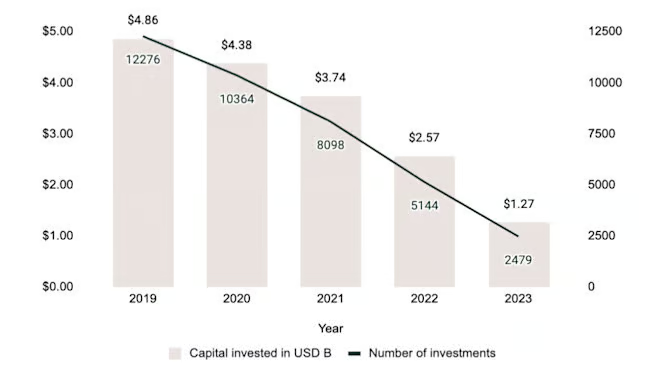
This landscape is the perfect playing field for solo GPs. They bring a wealth of expertise, networks, and a hands-on approach that is vital during the early stages of startup development, while leveraging the funding gap to join great cap tables. Their ability to bridge the funding gap and secure strong positions on promising cap tables has not gone unnoticed.
Rupa's success is part of a growing trend where solo GPs are gaining traction in the VC space. Institutions like British Business Bank are opening doors to these emerging investors: "I'm incredibly proud and humbled to be backed by British Business Investments, a subsidiary of British Business Bank, as their first ever solo GP commitment." This shift reflects a broader recognition of the value that solo GPs bring, particularly in terms of speed, and their ability to foster innovation in underserved markets.
Key facts
- Solo GP-led VC funds are on the rise.
They now account for 53.4% of all emerging VC funds launched in 2024. - Fund sizes.
Most solo GPs run very small micro funds. About 67% of new VC funds in 2024 targeted under $10 million, down slightly from 71% in 2023. - LP composition.
Support for solo GPs skews toward individuals and family offices, although some top solo funds have attracted institutional LPs, university endowments and fund-of-funds among them. - Fundraising scene.
The environment has tightened for new and solo GPs. Emerging managers raised only around 20% of total VC capital in 2023, a steep drop from around 50% in 2017.
The performance paradox
Solo GPs are adding a unique advantage to the startup ecosystem, leveraging agility and network to attract founders seeking partners who can execute quickly and offer high-value advice on the spot. In fact, the top 7 of the 20 highest-performing external co-investors on AngelList were solo capitalists, demonstrating their deal quality despite smaller fund sizes. Only time will tell their capability to outperform the big industry leaders.
However, the solo GP model encounters relevant drawbacks that require founder-mode expertise to navigate. In Europe, first-time fund closes dropped by 50% in two years, 66 in 2022 to 34 in 2024, with emerging managers securing just 20% of total VC capital in 2023 versus around 50% in 2017. Fundraising timelines are increasing substantially: the average time to final close is 15 months, and one solo GP spent 24 months raising a $12.5m fund, engaging 1,200 LPs for a 5% conversion rate.
This difficulty is mainly due to the general risk aversion in the market. In North America, 9 US mega-funds, a16z and General Catalyst among them, captured more than 50% of 2024 VC capital, crowding out smaller players. Deal-by-deal investing is gaining traction as an alternative to traditional fundraising, with platforms like Odin facilitating over 3,000 investments in 2024. This model allows solo GPs to bypass fundraises while maintaining portfolio flexibility. It is not perfect, but a good alternative for investing solo for the first time.
Female solo GPs are breaking barriers
There are independent female GPs whose success resonates loudly, however AUM disparities keep underscoring deeper inequities. While women manage 16% of European VC funds by count, they control just 9% of total capital, a €14.3bn gap relative to male peers. This stems from:
- Smaller fund sizes.
The average female-led solo GP fund totals €18.2m versus €24.5m for male-led peers. Even breakout funds like Araya Ventures' £20m vehicle are somewhat smaller than sector leaders like 14Peaks Capital's $30m pool. - LP composition.
Only 12% of institutional LPs have formal mandates to back female GPs, forcing women to rely on high-net-worth individuals, 45% of their LP bases, versus male GPs' 32%, with typically less ticket capacity.
As the venture model evolves, bolstered by AI-driven efficiencies and niche branding, solo GPs are set to redefine the industry's future. In the words of Maria Rotilu: "Solo GPs, once a rarity, will become a more mainstream force in early-stage venture. As the model evolves, we'll see new and reimagined approaches emerge, shaped by AI-driven efficiencies and strong niche brands that deeply resonate with founders and LPs. Just as AI is predicted to enable the first single-employee billion-dollar unicorn, solo GPs are set to shape this new era of venture investing: leaner, more agile, and precise, and ultimately driving superior returns."
Diving deeper into AUM disparities
- Gender-diverse teams achieve median IRRs 9.3% higher than male-only teams.
- Female-led funds of less than €25m deliver 22% higher portfolio revenue growth at Series A.
Conclusion
The solo GP model, long embraced in the U.S., is steadily gaining traction in Europe, driven by the need for agile decision-making and personalised portfolio management. The data confirms this rise, particularly in early-stage and underserved markets. While female GPs face persistent AUM gaps, they make a compelling case for LP diversification. With female solo GPs like Gloria Bäuerlein paving the way, the future of European venture capital may well be defined by lean, decisive teams that leverage data, automation and deep networks to drive innovation.
Want to learn more? Meet 8 extraordinary female VCs, Flyer One · The Power of Solo GPs, Visible.vc · Europe's VC scene versus the US, Sifted · Anamcara closes first fund, Sifted · How to set up a fund structure, Carmen Alfonso Rico for Sifted · Raising Common Magic I, Medium · Gloria Bäuerlein: navigating venture capital solo, LinkedIn
First appeared in our newsletter, March 2025.