AI adoption is up. Competitive readiness isn't
We have heard a lot around tech circles. A few weeks ago, a striking line stated that many companies have already been "kicked out of the arena", they just do not know it yet. The reason is simple. It captured something the market is only now beginning to understand: in AI, adoption is no longer the story. Organisational speed is.
Most serious companies now use AI in some form. McKinsey's latest global survey found that 88% of organisations use AI in at least one business function, up from 78% a year earlier. But only around one-third say they have begun scaling AI across the enterprise. The majority are still somewhere between experimentation and rollout. That gap matters. The market is splitting now between the companies that can actually change how work gets done right now.

Adoption is broad. Rewiring is rare
There is a lot of AI activity in the market right now. There is much less AI transformation.
That is the first real market divide of 2026. It runs between companies that have embedded AI into their operating model and those still decorating legacy processes with new tooling.
Capital is not just flowing into AI. It is concentrating
If enterprise adoption is one side of the story, capital markets are the other. The OECD's latest figures should be required reading for anyone investing in, building in, or regulating this space. In 2025, AI companies captured 61% of all global venture capital investment value, $258.7bn out of $427.1bn total VC. That is more than double AI's share in 2022, when it stood at 30%.

The concentration is not only sectoral. It is geographic. The US accounted for roughly 75% of global AI VC deal value in 2025. The EU27 accounted for just 6%. AI is diffusing broadly across organisations. But the economic upside is concentrating very narrowly. For founders, that means the competitive landscape is becoming more brutal, faster. For VCs, it means the AI trade is increasingly a scale-capital trade.
Europe is not missing AI. It is missing capture
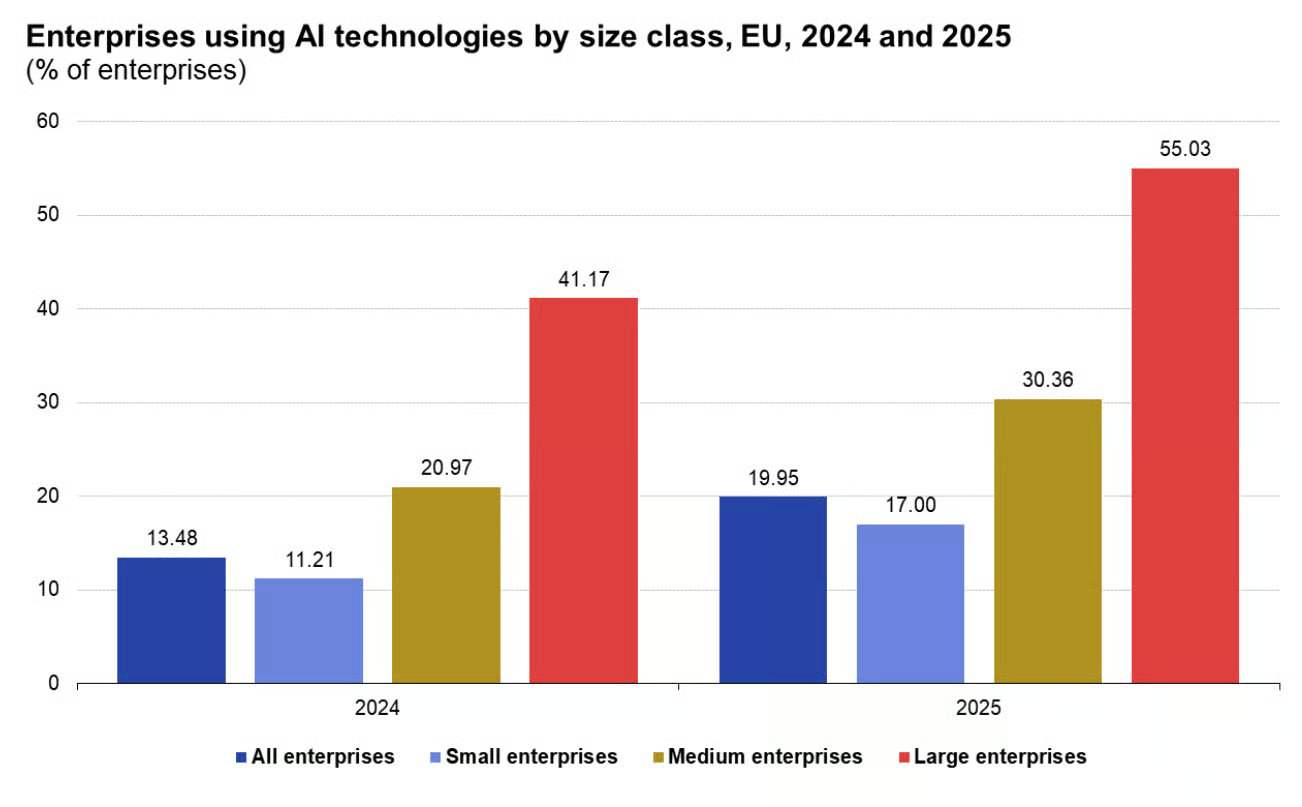
Europe is adopting AI. Eurostat reports that 19.95% of EU enterprises with at least 10 employees used at least one AI technology in 2025, up from 13.48% in 2024. Among large enterprises, adoption reached 55.03%. So this is not a story of European indifference. It is a story of uneven diffusion and weak capture. Europe has users. Europe has talent. Europe has startups. But when it comes to late-stage ownership, compute concentration, and venture-scale value capture, the centre of gravity is still overwhelmingly American. The OECD's 75% US versus 6% EU27 split makes that brutally clear.
The AI race is now an infrastructure story too
The European Commission is now treating AI capacity as industrial policy. In October 2025 it said the network had expanded to 19 AI Factories across 16 Member States, with more than €500m in joint investment in that third wave alone. Total commitments to the AI Factories and Antennas initiative now exceed €2.6bn. Earlier, in February 2025, the Commission launched InvestAI, an initiative designed to mobilise €200bn for AI investment, including a €20bn European fund for AI gigafactories.
Europe is no longer just talking about AI regulation. It is now explicitly talking about compute, capacity and industrial build-out. That matters because the next phase of the AI market is not purely a software race. It is increasingly a race across:
- Compute access
- Energy availability
- Procurement capacity
- Data location
- Security posture
- Industrial scale
Reskilling is no longer an HR issue. It is a competitiveness issue
The labour story is also getting sharper. PwC's 2025 AI Jobs Barometer found that skills demanded in the most AI-exposed occupations are changing 66% faster than in the least exposed ones. Meanwhile, the World Economic Forum estimates that by 2030, labour-market churn will affect 22% of today's jobs, with 170 million new roles created and 92 million displaced, for a net increase of 78 million jobs.

Taken together, the message is straightforward: the economic question is no longer whether AI will change work. It is whether firms and countries can adapt quickly enough to where work is moving. That is why reskilling should no longer be framed as a soft workforce initiative. As the usage of model capabilities is barely scratching the surface, reskilling for the future is a strategic priority for navigating labour-market impacts.

First appeared in our newsletter, March 2026.