€800 billion. That is the amount of investment that Europe needs to close the competitiveness gap with the US and China, according to Mario Draghi's estimates. This realisation unfolds two questions: where to find that money, and how to make sure it is catalysed to innovation and new businesses?
Europe's big problem, or opportunity
Europe has the talent but lacks local funding to finance its next unicorns. Fragmented and underfunded VC markets, combined with limited institutional investment backing alternative assets, fuel dependence on foreign capital, and the risk of losing top talent abroad.
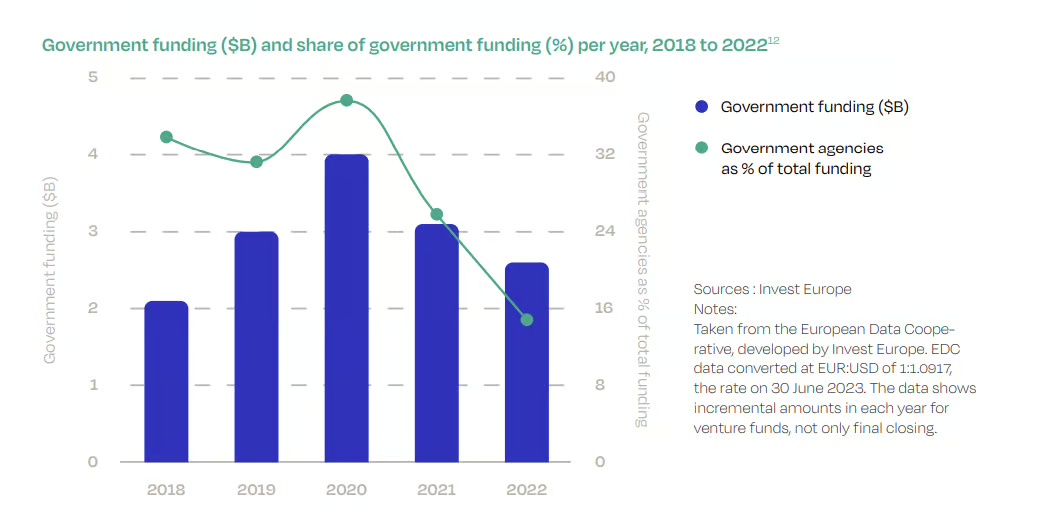
Amongst this lack-of-funding problem, a core issue identified is the insufficient involvement of institutional investors, such as pension funds and insurers, in funding European VC funds, particularly at later growth stages. Governments are not enough anymore. As an example, 30% of the EU budget is spent on climate change today, which represents until 2027 a total of €87 billion. According to European auditors, this sum represents less than 10% of the investment needed to reach the 2030 targets the EU set for its transition, with real needs around one trillion euros per year.
The conclusion is that, while government funding has played its role in Europe up until now, EIF, KfW, Bpifrance, amongst others, tougher economic situations in the continent are slowing down their efforts.
Europe's private fund-of-funds market remains significantly underdeveloped. Unlike in the U.S., European universities lack sizable endowments or foundations with the capacity to invest in venture and growth funds. The gap can be bridged by institutional investors who could pool, manage and invest sufficient amounts into private fund of funds.
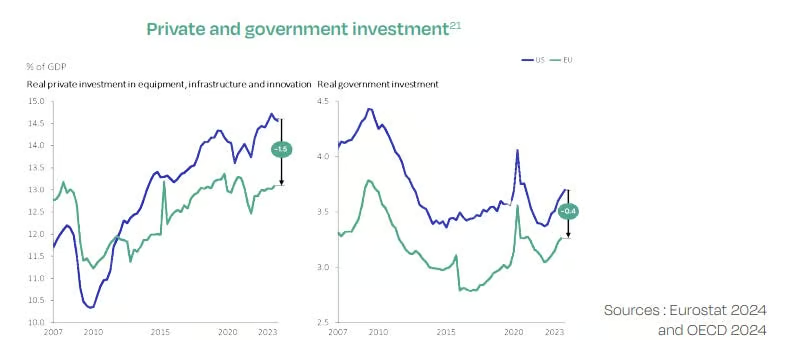
These investors have never fully bet on capital risk: despite progress, the share of alternative assets under management flowing into European VCs has declined in the past two decades. Today, 8% of European asset manager allocation in alternative assets is in venture capital, half of the US average of 16%.

Europe is suffering from:
- Capital shortage.
European institutional investors contribute only around 30% of VC funding versus 72% in the US (France Digitale). - Small scale.
Between 2013 and 2023, Europe produced just 11 billion-dollar VC funds compared to 137 in the US (EIB report). - Lack of institutional investors.
Government funding alone does not suffice. Only 0.024% of European pension fund assets are invested in local VCs, highlighting enormous untapped potential (France Digitale). With very little investing from university endowments and foundations, privately managed fund of funds are a must for Europe.
Fund-of-funds: the investment case
FoFs can be a safer entry into venture and growth capital, especially attractive for pension funds, insurance companies, and other institutional investors under-exposed to VC because of their risk profile.
- Diversification.
A single FoF can provide exposure to 20 or more VC funds, significantly reducing the risk compared to direct investments (Pattern Ventures). - Stable returns.
With less volatility, FoFs help investors smoothly navigate the notorious venture J-curve, implying a clearly de-risked way to participate in VC, as the portfolio of the underlying fund mitigates poor performance of single assets. - Expert management.
Professional teams handle selection and due diligence, helping LPs achieve net returns that rival direct VC fund investments.
The return record
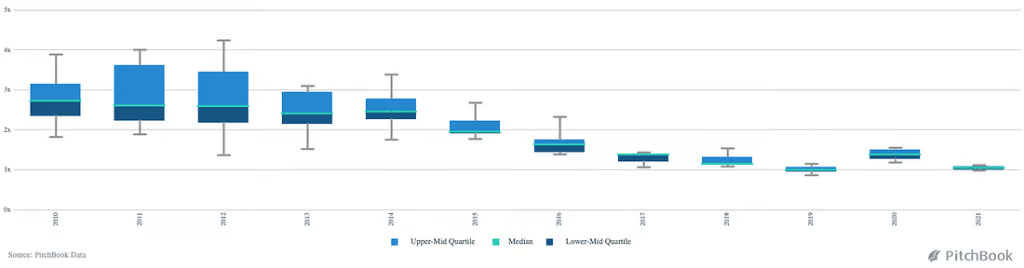
Median returns (TVPI) for venture FoFs historically average around 2.5x, typically without loss of principal (Level Ventures).
Venture capital fund-of-funds TVPI by vintage
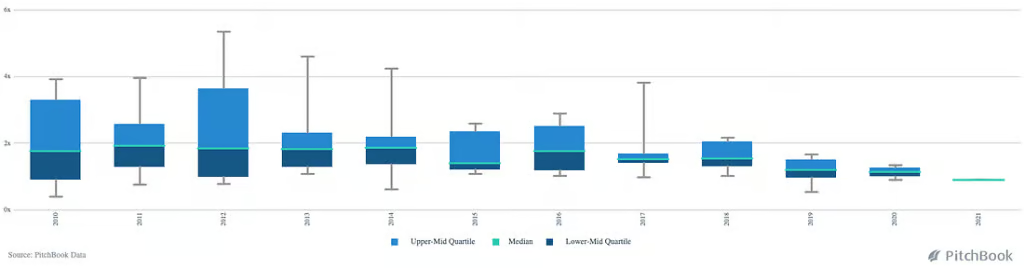
Venture capital direct funds TVPI by vintage
- Superior access. Access to top-performing and exclusive funds that are often closed to new LPs.
- Lower return dispersion. FoFs have a 0.58x spread from top to bottom quartile, while direct VC has a 1.21x spread.
- Fees are justified in VC. The top 5% of VC funds outperform the median by around 45%, while in hedge funds it is only around 10%. The gap absorbs the second fee layer.
- Cost and time efficiency. FoF fees can be cheaper than paying an in-house management team, and it is operationally simpler.
- The "double layer of fees" objection. A typical objection is that fees eat into returns. The reality is that VC's return dispersion is so high that FoFs still outperform direct VC net of fees. FoFs are a lower-risk, consistent-return option.
- The "signals weakness" objection. Many consider that using a FoF means the LP cannot execute a direct VC strategy. Actually, most LPs are generalists; choosing a FoF shows smart delegation and a focus on performance.
- The "less prestige" objection. Direct VC investing is more engaging and high-status. However, top FoFs host curated LP and GP events, introductions, and experiences that enrich the LP journey.
Closing thoughts
Fund-of-funds represent a powerful strategy for Europe to harness institutional capital, drive innovation, and enhance competitiveness. With targeted policy support and savvy investors recognising their potential, FoFs can transform Europe's fragmented funding landscape into a powerhouse of global innovation. The benefits outweigh the drawbacks, especially for institutional investors looking for reduced risk, and for good assets that can, as a side benefit, catalyse innovation.
Key takeaways: we need to develop all asset classes in Europe
- FoFs offer critical diversification and stability, especially suited to cautious institutional investors.
- Europe requires €750 to 800 billion in additional investment annually to close its competitiveness gap with the US and China, approximately 4.4 to 4.7% of EU GDP. In this context, Europe needs FoFs to unify fragmented markets and unlock vast institutional savings.
- The European VC share is only 5% of the global total, compared to 52% in the US and 40% in China, highlighting the need for stronger local funding.
- European VC funds have been much smaller than in the US, with only 11 funds over $1 billion between 2013 and 2023, versus 137 in the US.
- The European pension fund market remains underdeveloped, holding only 32% of GDP in 2022, far behind the 142% in the US and 100% in the UK, indicating untapped capital potential for VC investments. Are fund of funds the way to accelerate the deployment?
- FoFs offer superior access to exclusive funds, with lower return dispersion, 0.58x spread versus 1.21x for direct VC, and their fees, though higher, are justified by higher returns from top VC funds.
Europe must strengthen its entire venture capital stack, and that means developing all asset classes. Public capital has a critical role to play in accelerating the growth of private fund-of-funds structures, to act as LPs to Europe's VC ecosystem.
Want to learn more? The Fund-of-Funds Fallacy, Pattern Ventures · Unlocking Investments for Competitiveness, France Digitale · Managed Funds Association, Alternative Investments
First appeared in our newsletter, June 2025.