The old story is over. The interesting one just started
For a long time, ETFs were the sensible corner of the portfolio. Useful, low-cost, liquid. A cleaner way to hold the S&P 500 or tilt into a sector. That version of the story is still true. It just isn't the interesting part anymore.
Something more important is happening. The ETF is becoming the instrument investors reach for when the thing they actually want to own is hard to get to directly. Uranium. Private credit. Infrastructure. Defence technology. AI. Robotics. Space. These are not neat allocations. They sit across public equities, private markets, geopolitics, industrial policy, and venture-style innovation, sometimes with very messy underlying liquidity. And yet, more and more of them are being pulled into ETF form.
The numbers make this impossible to ignore. Global ETF assets hit a record $21.91 trillion at end-April 2026, surpassing the previous high of $21.24 trillion set in February. Year-to-date inflows through April reached $856.38 billion, already exceeding the full first-half totals of any prior year. Q1 alone brought $626.42 billion, the highest first-quarter figure ever recorded. Europe is no longer a sideshow: European ETF assets reached $3.22 trillion at end-2025, after record annual inflows of $396.84 billion.
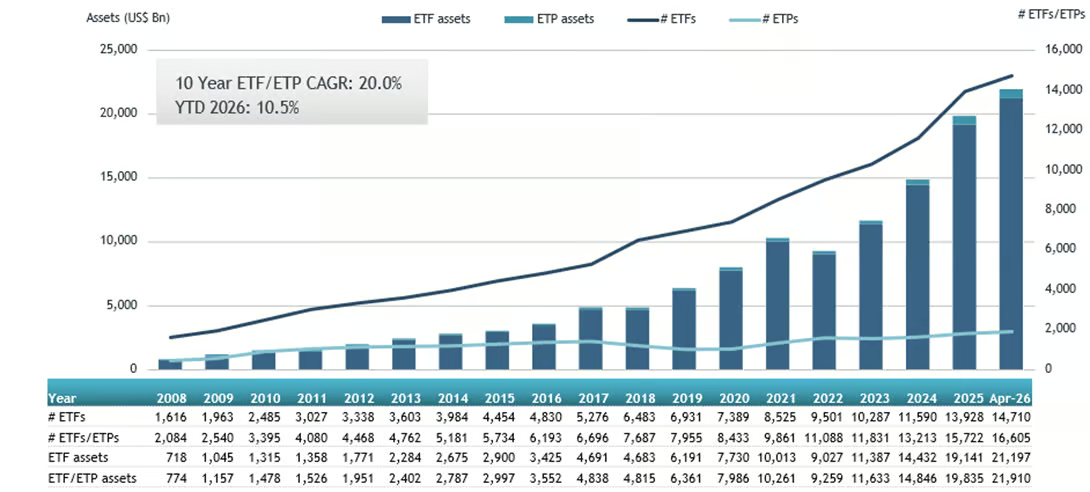
The product category is growing. But the more important question is: what is the ETF now being asked to do?

Adoption is settled. Usage is the new question
The market has moved past the question of whether investors like ETFs. They do.
.avif)
BBH's 2026 Global ETF Investor Survey found that 96% of professional investors plan to increase ETF allocations over the next 12 months, 98% plan to increase active ETF allocations, and 99% said they would consider private-markets ETFs.
.avif)
Institutional behaviour is shifting too. Cerulli and Invesco research published in April 2026 found that North American institutional ETF holdings reached approximately $337 billion in 2025, nearly doubling in five years. Institutions are using ETFs not only as core holdings, but for liquidity management, tactical allocation, and, critically, as public-market proxies for private-market exposure.
.avif)
That last phrase is the one to sit with: public proxies for private markets. A pension fund cannot practically underwrite 200 small AI companies one by one. A retail investor cannot usually access venture funds, private credit vehicles, or institutional infrastructure mandates. A sovereign wealth fund may want a liquid tactical position before committing to a ten-year lockup.
So the ETF steps in. It becomes a discovery layer, a pricing signal, a benchmark and, increasingly, a transition vehicle between public and private allocation. That is not "ETFs are growing". We knew that. The shift is that ETFs are becoming the default structure for markets investors want but cannot easily own directly. And that makes the ETF part of the market's plumbing, rather than just a product sitting on top of it.
Why BlackRock belongs in the frame
This is not an analysis about BlackRock. But BlackRock is one of the clearest indicators of where the market is heading, because no other firm is simultaneously building at this scale on both sides of the public-private line.
BlackRock entered 2026 with $14 trillion in AUM, after record net inflows of $698 billion in 2025. iShares alone gathered $527 billion in net inflows last year. At the same time, BlackRock has been building hard into private markets. It completed the acquisition of Global Infrastructure Partners in October 2024, creating an infrastructure platform with approximately $170 billion in AUM across more than 100 countries. In July 2025, it completed the acquisition of HPS Investment Partners, forming a combined Private Financing Solutions platform with around $190 billion in client assets. And at its June 2025 investor day, BlackRock set its first firmwide target for private-markets fundraising: $400 billion by 2030.
The signal is not that BlackRock is big. The signal is that the world's largest ETF platform is simultaneously building private credit, infrastructure, data, and portfolio-technology capabilities at scale. The firm at the centre of ETF distribution is positioning itself at the centre of public-private portfolio construction. That tells where the market is moving: away from separate buckets called public markets and private markets, towards integrated structures where capital flows between them more fluidly. And the ETF is one of the cleanest vehicles for that transition.
Active ETFs: the format itself has evolved
One reason this convergence is happening now is that the ETF format is no longer limited to tracking an index. ETFGI reported that actively managed ETFs held $2.12 trillion in global assets at end-March 2026, and gathered $245.21 billion of net inflows in Q1 alone, up 70% from the previous Q1 record set in 2025. BlackRock projects global active ETF AUM could rise from $1.4 trillion in mid-2025 to $4.2 trillion by 2030.
This matters because active management makes the format more flexible. The new story is about packaging strategy, outcomes, income, private-market-adjacent exposure, thematic views, and dynamically managed positions, all inside a structure investors already trust and understand. The format has earned investor confidence over two decades. Now issuers are testing how much complexity that confidence can carry.
.avif)
Why this is happening now
Three structural forces converged to make the ETF the default wrapper for complex exposure.
- The first is regulatory.
The SEC's 2019 approval of semi-transparent active ETF structures, and subsequent expansions, unlocked strategies that previously could only live in mutual funds or hedge fund wrappers. In Europe, the broadening of UCITS-compliant ETF frameworks did something similar for retail distribution. Active, thematic, and outcome-oriented strategies could suddenly sit inside the ETF, and once they could, issuers moved fast. - The second force is the post-ZIRP reallocation.
A decade of low interest rates pushed institutional capital deep into private markets: private credit, infrastructure, venture, real assets. Now that capital is there and growing, investors want the things that private markets never offered well: liquidity options, public benchmarks, and real-time pricing signals for exposures they have already committed to in locked-up form. The ETF-as-access-layer thesis is not emerging from nowhere. It is a direct consequence of the massive private-market allocations that preceded it. Investors are not asking ETFs to replace those allocations. They are asking ETFs to make them more navigable. - The third force is distribution infrastructure.
The rise of model portfolios, direct indexing platforms, and digital wealth management has reshaped how capital is allocated at scale. More and more investment decisions are made through systems that require wrapper compatibility, and the ETF is the wrapper those systems are built around.
Five themes where ETFs are already doing this work
- 1. Uranium: the scarcity trade.
The IEA says nuclear interest is at its highest since the 1970s, but four countries control more than 75% of mine production and output covers only around 90% of utility needs. The Global X Uranium ETF: $7.76bn in net assets. It does not fix supply concentration, but it lets investors express a scarcity view without building the position asset by asset. - 2. Private credit: where the engineering gets serious.
The SPDR SSGA Apollo IG Public & Private Credit ETF, launched February 2025, allows 10 to 35% Apollo-sourced private credit, with firm bids covering seven-day stress redemptions. BondBloxx's Private Credit CLO ETF: $201.7m, 87.4% in private-credit CLOs. Whether daily-traded vehicles should hold assets not built to trade daily is unresolved. That is exactly why it matters. - 3. Infrastructure: the proxy problem.
PwC forecasts $151.1 trillion in cumulative global infrastructure investment by 2050. The iShares Global Infrastructure ETF: $10.69bn, but it is 77 listed equities (NextEra, Transurban, Aena), beta 0.59, P/E 22.64. Investors are buying companies that own infrastructure, rather than infrastructure as an asset class. The ETF creates the on-ramp. It is not the destination. - 4. Defence: geopolitics becomes investable.
Global military spending hit $2.887 trillion in 2025 (SIPRI). European NATO: +14%, fastest since 1953. The EU's ReArm Europe plan: up to €800bn. The Global X Defense Tech ETF: $8.09bn. For founders in dual-use, cyber, or AI-adjacent defence, public-market capital is now pricing and benchmarking your category. That changes the fundraise narrative years before an IPO. - 5. AI and space: what is actually in the basket?
The iShares Future AI & Tech ETF: $3.17bn, but top 10 holdings are 48.65% of the fund, almost entirely semiconductors (AMD, Marvell, Micron, NVIDIA, SK Hynix). The application and software layers are largely absent. This is a chip bet, rather than an ecosystem bet. The Procure Space ETF ($742.5m) now trades on Coinbase: the wrapper evolving by distribution channel, not just asset class. For founders: once a category gets an ETF, index providers define what is in it. That classification determines which flows hit your stock. It is not administrative. It is economic.
Where the structure fails
This story needs honesty about its limits, and those limits connect directly to the hardest questions raised above. Start with the cleanest example. BlackRock closed and liquidated the iShares Frontier and Select EM ETF after citing persistent liquidity challenges, including delays and limits on currency repatriation in certain markets. The final trading date was January 6, 2025. The fund had operated for nearly 12 years before the underlying market mechanics made continuation untenable. The Financial Times described it as part of a wider retreat by ETFs from frontier markets.
The lesson is clear: the ETF cannot fix broken market plumbing. When underlying liquidity, pricing depth, and market-making infrastructure are not there, the product cracks, regardless of investor demand.
But the frontier-market case is the easy one. The harder question is whether the same structural risks apply, in subtler forms, to the private credit ETFs now being launched. What happens in a credit stress event where multiple private credit ETFs face simultaneous redemption pressure? The liquidity backstop has not been tested under fire.
None of this means private credit ETFs will fail. It means the next phase of ETF expansion will be judged differently. Not by AUM growth or product launches, but by the quality of the structure underneath: liquidity engineering, valuation rigour, disclosure standards, stress-test results, and the credibility of the counterparties standing behind the bid. The frontier-market closure and the private credit launches are two sides of the same coin: the ETF format works when the underlying mechanics support it. The question is how far those mechanics can be stretched before something gives.
The European question
There is a structural question sitting underneath all of this that Europe has not fully answered. The spending commitments are real. The ReArm Europe plan targets €800 billion. PwC's infrastructure outlook points to a major renewal cycle across Europe and North America. European savers, pension funds, and asset managers have meaningful capital to deploy.
European ETF adoption is accelerating, $3.22 trillion in assets at end-2025 with record inflows, and ETFs can play a genuine role in broadening participation. They can create benchmarks for strategic sectors, make themes visible to a wider investor base, and give institutions a way to build positions in areas like defence, energy, and AI infrastructure before making larger private-market commitments.
But the format alone cannot solve what are deeper capital-market problems. Europe still has a relatively thin pipeline of growth-stage companies going public. IPO pathways remain weaker than in the US. Pension participation in innovation is structurally lower. The gap between early-stage venture and public-market liquidity is wider.
An ETF can package the public companies that exist. It cannot create the companies that don't. If European capital remains structurally underexposed to the sectors shaping the next decade, AI infrastructure, defence technology, energy systems, industrial automation, deeptech, the ETF can help at the margins. But the core problem is upstream: company formation, growth capital, and the institutional risk appetite to back them. This deserves its own analysis. For now, the point is that the ETF is a useful layer in a functioning capital-market stack. It is not a substitute for the layers that are missing.
What we are watching next
The next ETF cycle will not be about more products. It will be about more complex exposures moving into a format originally designed for simple ones. Two additional observations:
- For VCs and founders, thematic ETFs are becoming useful signals in venture-backed markets, because they show how public-market capital is forming views around categories like defence, AI infrastructure, cybersecurity, nuclear, robotics, energy, and climate infrastructure.
- ETF AUM and inflows can reveal crowding, because themes with large ETF exposure and strong inflows may already be priced around consensus, while newer ETF categories with lower AUM may point to areas where public-market pricing has not fully caught up with private-market opportunity.
First appeared in our newsletter, May 2026.