The numbers most people are still missing
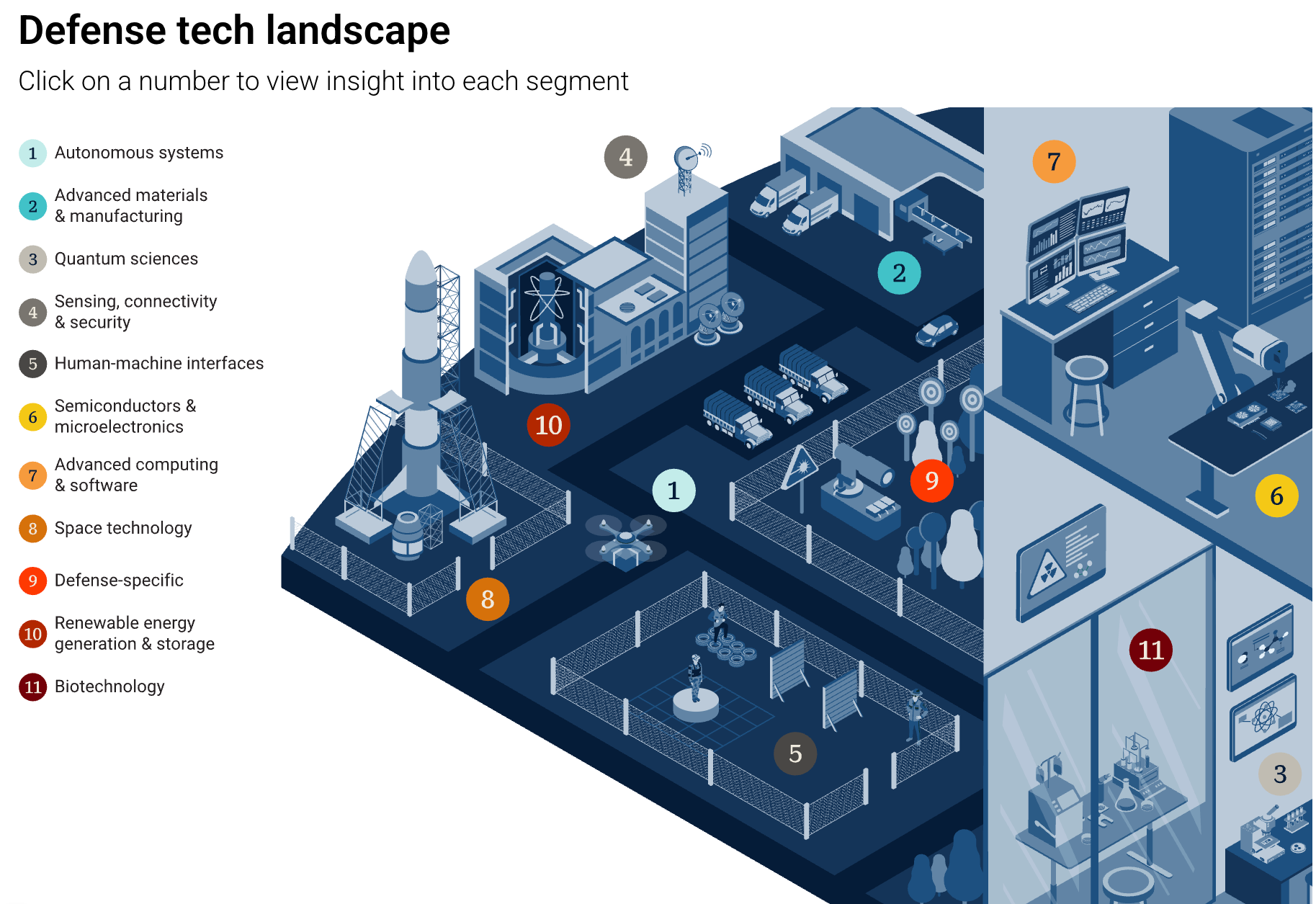
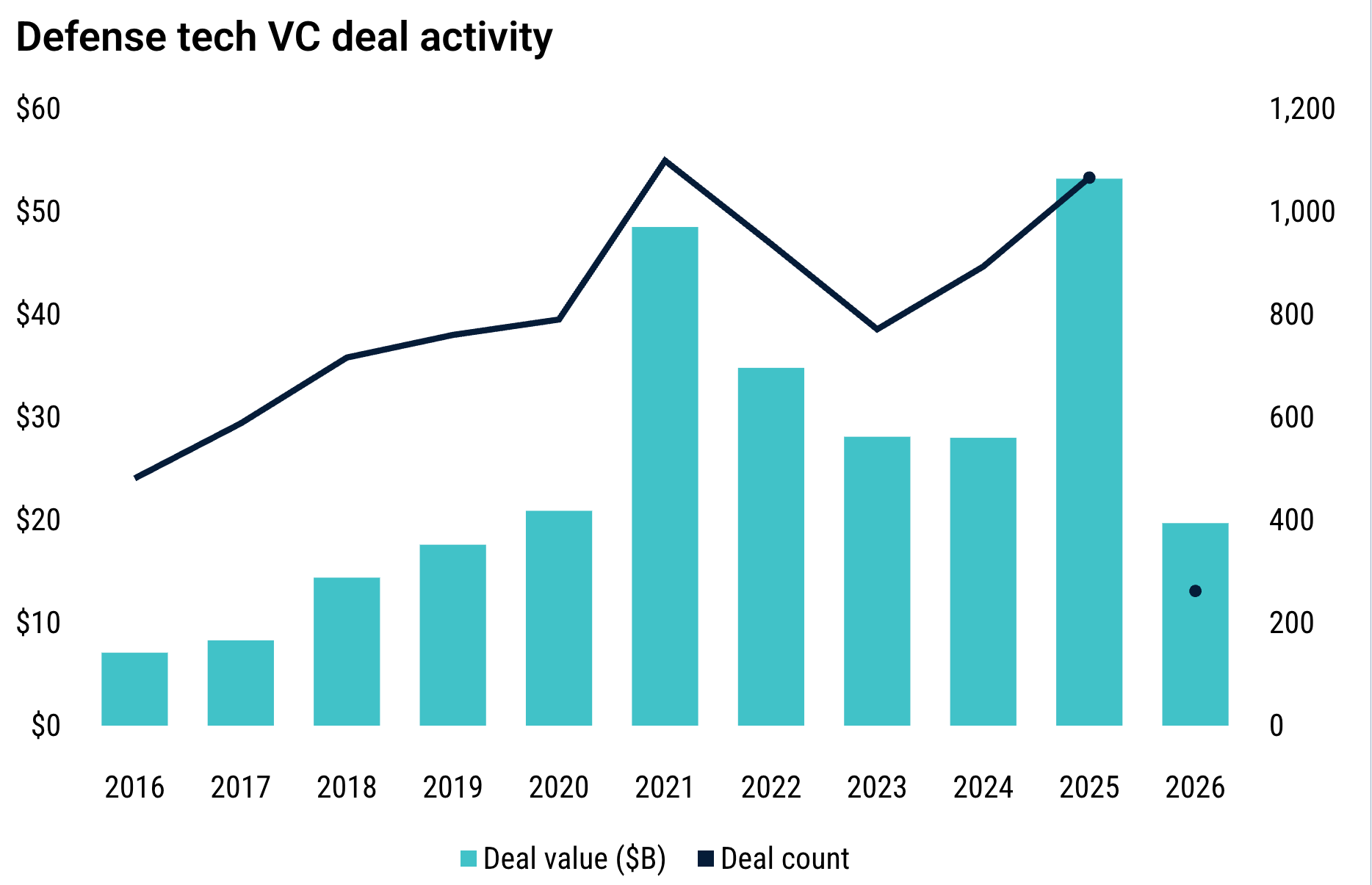
Global venture capital invested in defence and dual-use technology reached $49.9 billion across 966 deals in 2025, nearly double the $27.2 billion invested in 2024, according to PitchBook's year-end defense tech data. The momentum has carried into 2026: PitchBook counted $19.8 billion across 262 deals in the first quarter, a new quarterly record that broke the previous high of $17.9 billion set in the second quarter of 2025, per PitchBook's Q1 2026 report.
Source: Pitchbook
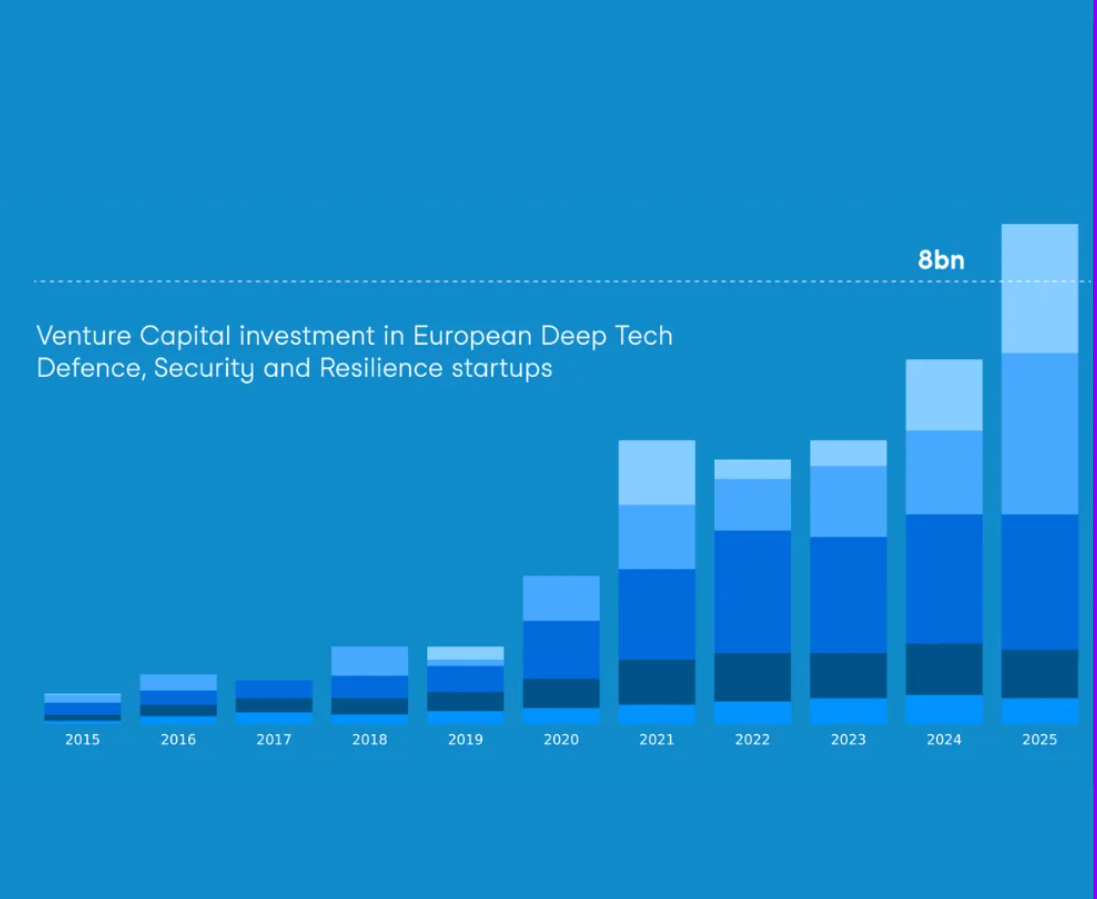
Europe's slice of that story has its own shape. European defence, security and resilience startups raised $8.7 billion in 2025, up 55% year on year and roughly four times the level of five years ago, per Dealroom and NATO Innovation Fund data. Defence now accounts for roughly 10% of all European VC funding, up from under 1% before 2020, according to New Fund Capital's analysis of the same Dealroom dataset. A separate deal-level count from FCF Fox Corporate Finance's DefenseTech Venture Capital Report 2026 puts the European DefenceTech VC market at 154 deals worth €2.8 billion in 2025, up 148% in deal count and 718% in volume versus 2021, a compound annual growth rate of 69% over that period. Germany leads the region, accounting for 42% of invested capital (about €2.2 billion) though only 14% of transactions, a gap that points to a smaller number of very large German rounds.
The headline is easy to write: defence tech is growing fast. The more interesting question is why the growth is happening now, and what kind of companies it will create.
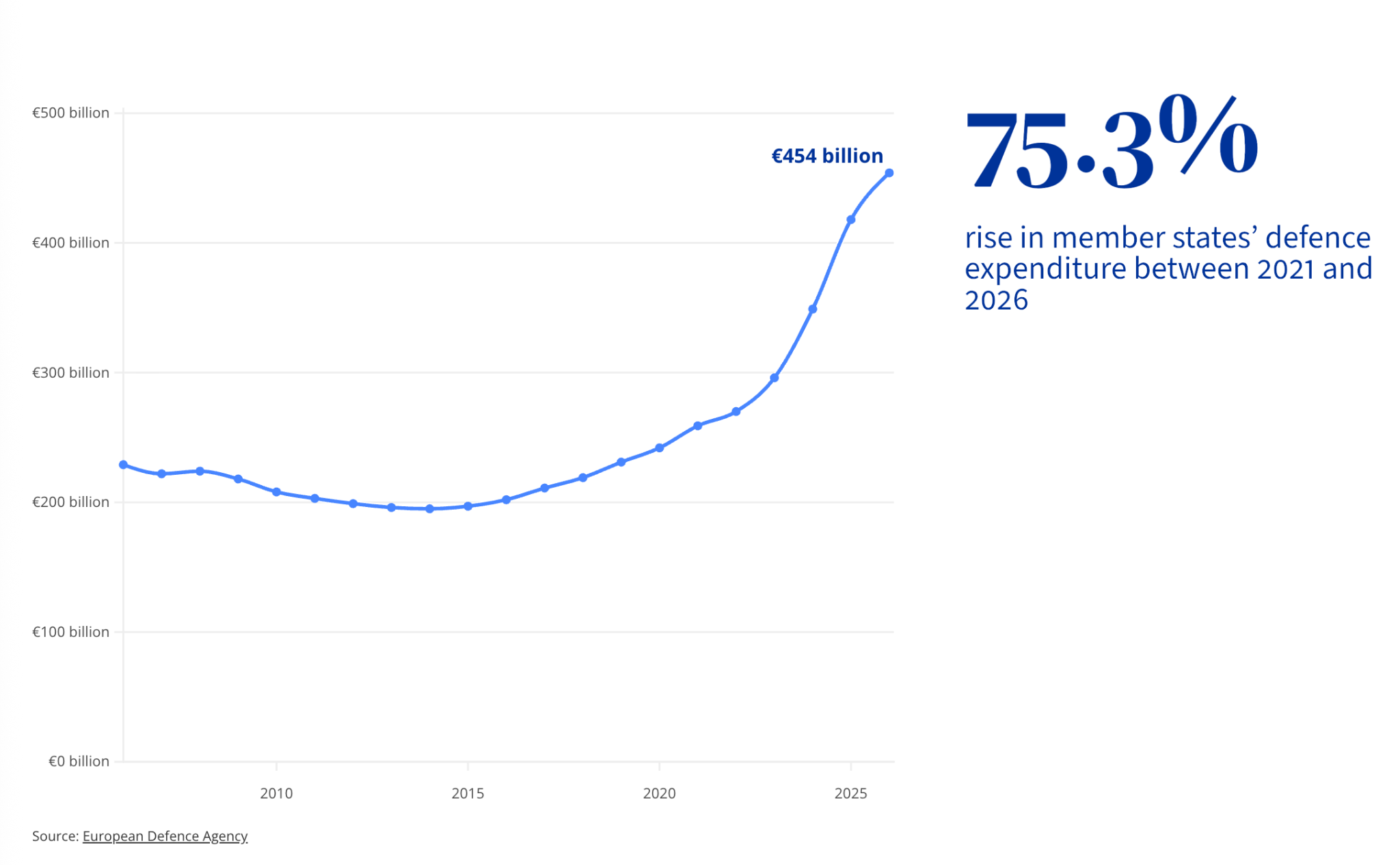
The demand signal has become much harder to ignore. The European Defence Agency estimates that EU member states spent about €381 billion on defence in 2025, equivalent to 2.1% of GDP, with defence investment close to €130 billion. NATO allies have separately committed to reach 5% of GDP on defence and security-related spending by 2035, including at least 3.5% for core defence requirements, a target agreed at the 2025 NATO summit in The Hague. These are not venture numbers, but they are the backdrop against which venture numbers start to make sense.
The important shift is that Europe is moving from a discussion about under-spending to a discussion about industrial capacity. Money has to turn into ammunition, drones, sensors, software, communications, satellites, manufacturing capacity and the infrastructure around them. That creates a much more concrete demand signal for technology companies than a thematic shift in investor sentiment alone.
Where the concentration sits
Dual-use tech shows in miniature the same pattern this letter has traced across all of venture this year: record capital alongside a falling deal count. The FCF report finds that five companies (Helsing, TEKEVER, Quantum Systems, Iceye and Destinus) account for almost 60% of all capital raised in European DefenceTech since 2021. And the transatlantic gap remains wide. US-based Anduril alone generated more revenue in 2025, $2.1 billion, than the entire European defence-tech VC ecosystem raised that year in pure defence-tech rounds, $1.5 billion, and the US has captured 85% of all NATO-related defence VC funding since 2019, against Europe's 6.2% share, though that European share is growing quickly, according to New Fund Capital's analysis of Dealroom and NATO Innovation Fund data.
Chatham House frames the broader picture this way: VC-backed defence startups in the US and Europe raised a combined $7.7 billion between January and October 2025 alone, more than double the prior comparable period, with a growing share of EU-based AI and dual-use startups explicitly citing European strategic autonomy as their motivation.
Hence, if a handful of companies account for a very large share of the capital, the market is not yet broad. It is a market in the process of discovering its winners. That is good news for the companies that have crossed the credibility threshold, and a reason to be careful about extrapolating headline funding growth into a uniformly attractive opportunity. The US comparison sharpens the point. Europe is building a venture ecosystem around a much larger defence-spending programme, but it starts with less capital, less procurement scale and fewer companies that have already demonstrated the ability to sell at volume. The opportunity is therefore not simply to finance more European defence startups. It is to build companies that can become meaningful suppliers.
Case Study: Helsing
Helsing's funding history is a useful example at this point because it illustrates the gap between private-market expectations and contracted defence revenue. In June 2025, the company raised €600 million in Series D at a valuation of roughly €12 billion, led by Daniel Ek's Prima Materia. In July 2026, it closed a $1.8 billion Series E at an $18 billion valuation, making it Europe's best-funded defence-tech company.
The more important question is what sits underneath that valuation.Helsing has now moved beyond pilots into funded defence programmes. In November 2025, Helsing and Saab Germany signed a three-year contract worth a three-digit-million-euro amount to integrate Helsing's Cirra AI software into Saab's Arexis electronic-warfare suite for the Eurofighter. In February 2026, the Bundeswehr awarded Helsing an initial €269 million contract for HX-2 loitering munitions, with options that could have taken the programme to €1.46 billion. The Bundestag budget committee subsequently capped spending at €1 billion per producer and required further approval for purchases beyond the initial €269 million.
That distinction matters: a framework ceiling is not the same as contracted revenue. Helsing has demonstrated that government demand can convert into meaningful procurement, but a substantial part of the longer-term opportunity remains dependent on future budget decisions and programme execution.
This makes Helsing a useful case study for dual-use and defence tech: how much of the valuation is backed by signed contracts, how much depends on future procurement, and what evidence exists that the technology can perform at operational scale?
Case-study rubric
- Contract stage: Has the company moved from pilots to funded, multi-year procurement?
- Backlog vs. opportunity: What is contracted versus merely available under a framework or option?
- Procurement constraint: Who controls the next tranche of spending?
- Customer diversification: One government or multiple allied customers?
- Performance evidence: What independent operational evidence exists?
- Valuation gap: How much of the valuation is supported by contracted revenue versus future procurement?
Who is writing the cheques, and how that is changing
The composition of the capital is shifting from angel-heavy syndicates toward institutional-sized tickets. Dedicated defence-fund fundraising hit $7.1 billion in 2023, reset to $3.3 billion across nine funds in 2025, and is now reconcentrating into fewer, larger vehicles backed by institutional LPs, according to S&P Global Market Intelligence data reported by Nexi. The same analysis reports that APG, the Dutch pension fund managing €601 billion, said in June 2026 that defence-adjacent technology is now “front of mind” for its allocation strategy, per Private Equity International's reporting, and that AVP and Earlybird have launched E2D, a joint €500 million dual-use growth fund.
Public capital is moving in the same direction. The European Innovation Council opened its instruments to defence and dual-use technologies from 17 June 2026, offering up to €30 million in direct equity and co-investment in rounds typically sized €50 million to €150 million or more, the first time any EU funding programme has invested direct equity in defence companies. In March 2026 the European Investment Fund committed €50 million to Join Capital's Fund III (targeting €235 million), its largest defence commitment to date, backing 25 early-stage deeptech companies across defence, dual-use, security and space.
The more telling change is not the size of any one cheque. It is the emergence of a capital stack around the category. The EIF is backing specialist funds. The EIC can now invest directly into defence companies. Growth managers are raising dedicated vehicles. Pension capital is openly looking at defence-adjacent technology. That gives companies more ways to finance the awkward middle of the journey, between a technically convincing prototype and an industrial-scale business.
That middle is where Europe has historically struggled. Seed money can prove that something works. A €50 million or €100 million round can fund a factory, certification, inventory, hiring and international expansion, but only if there is enough confidence that the product will actually be bought. In defence, that confidence depends on procurement timelines, government requirements and production capacity as much as it does on technology.
For fund managers and founders, the practical read is this: the capital is real and growing, but it is not evenly distributed, and it increasingly rewards teams that can show both defence and commercial traction rather than a single government customer. Several investor guides describe this as the difference between a fundable dual-use company and an unfundable pure defence contractor, per Round Funded's overview of active defence tech VCs.
The next bottleneck is not necessarily capital
The market is now large enough that the next constraint is likely to be execution. Dealroom and the NATO Innovation Fund's 2026 analysis is revealing: late-stage European defence, security and resilience investment reached $4.7 billion in 2025, more than three times the prior year, while early-stage investment fell 10% to $1.1 billion and breakout-stage funding fell 13% to $2.8 billion. The market is not simply getting bigger. A larger share of the money is moving toward companies that are already further along.
That changes what investors should look for. The scarce asset is not another interesting drone, sensor or AI application. It is a team that can get from a working product to a repeatable procurement process and then manufacture enough of it to matter.
This is also where dual-use can be useful, but only if it is real. A company that sells the same underlying technology into commercial and defence markets can diversify its customer base and learn faster, but the two markets have very different buying processes. Commercial customers may sign in weeks or months. Defence customers can require qualification, testing, budget cycles and formal procurement. The best dual-use companies will not pretend those differences do not exist. They will build the organisation around them.
MARKET PULSE: Concentration
Deal count eased from Q1 2026's record pace, but the average defence tech round still grew, to roughly $91 million from about $81 million in Q1, as investors concentrated more capital into fewer, larger, increasingly dual-use companies. That is the same pattern this issue traces across Europe: a market whose capital is scaling faster than its number of backable companies.
Source: PitchBook, Q2 2026 Defense Tech VC First Look.
Source: Pitchbook
The bear case
None of the above is wrong, but it is one-sided. A market this concentrated also has a small number of ways to go badly wrong. The €91 million average round size is being pulled upward by a handful of very large financings as we have seen (FCF). A procurement setback at one of those companies could therefore have an outsized effect on sector-level funding and valuation data.
The question is whether concentration reflects quality or excess: The US market offers a useful warning. Anduril CEO Brian Schimpf said in June 2026 that he believed defence tech had entered “a bit of a bubble,” arguing that successful companies attract imitational capital and increasingly risky behaviour. (Fortune) None of this proves European valuations are excessive. It does, however, reinforce the risk that investors are underwriting years of future growth and procurement before that demand is fully contracted.
The spending thesis is political, not automatic: NATO members committed at The Hague to reach 5% of GDP in defence and defence-related spending by 2035, including 3.5% for core defence. (NATO) But implementation is already uneven. Spain has rejected the 5% figure and says it can meet its NATO commitments at 2.1% of GDP. (Reuters) SIPRI estimates that reaching 3.5% across NATO by 2035 would require roughly $1.4 trillion more in annual military spending than in 2024, underscoring the fiscal and political challenge. (SIPRI)
The bear case, then, is not that European defence spending will disappear. It is that capital has moved faster than procurement, valuations have moved faster than contracted revenue, and the spending commitments underpinning the next wave of demand remain subject to national politics and budgets.
Europe's scaling problem
Europe does not lack technical talent or defence demand. It has a harder problem: turning fragmented national demand into companies that can scale across a continent.
That is why procurement policy matters as much as the amount of money being announced. The European Commission's defence agenda is increasingly focused on joint procurement, common standards and strengthening the European Defence Technological and Industrial Base. NATO is doing something similar at alliance level, positioning itself not only as a buyer, but as a requirement setter, standard setter and aggregator of demand.
If that works, the economics of European defence tech change. A startup that wins one ministry is a useful supplier. A startup whose product can be adopted across several allied countries is a platform. The difference is enormous for venture returns, because the second company has a path to scale that does not depend on winning a new procurement battle from scratch in every market.
This is the part of the story that is still underappreciated. Europe does not need to reproduce Silicon Valley's defence ecosystem exactly. It needs to make its own procurement market easier for high-growth technology companies to navigate. If it can do that while defence budgets rise, the supply of capital and the supply of customers start reinforcing each other.
What this might mean for investors
For LPs, the question is no longer whether defence is investable. The more difficult question is where returns will be. At the early stage, specialist managers may have an information advantage because technical and procurement expertise are still scarce. At growth stage, the advantage may shift toward managers who can tell the difference between a company with real procurement pull and one benefiting from the theme. Across both stages, the strongest investors will probably be those who understand that defence is not one sector. Autonomy, sensing, communications, cyber, space, energy, materials and compute each have different technical and procurement cycles.
For founders, the standard is moving too. A pitch built around geopolitics is not enough. Investors will ask the same questions they ask elsewhere: who pays, how much, how often, how long does deployment take, what has to be certified, what is the manufacturing bottleneck, and what happens if the contract arrives a year later than planned?