Quick overview of European tech in Q2 2025
Europe's tech scene is shifting. For the first time, Deep Tech, science- and engineering-driven innovation, has overtaken AI as the top focus for investors. Recent data confirms this shift. We explore the current dynamics of Deep Tech and hardware, highlighting why investors are prioritising these complex, tangible innovations, and how AI is evolving from a standalone, vertical focus to an enabling, horizontal force throughout the deep tech ecosystem.
Deep Tech: European sovereignty re-imagined
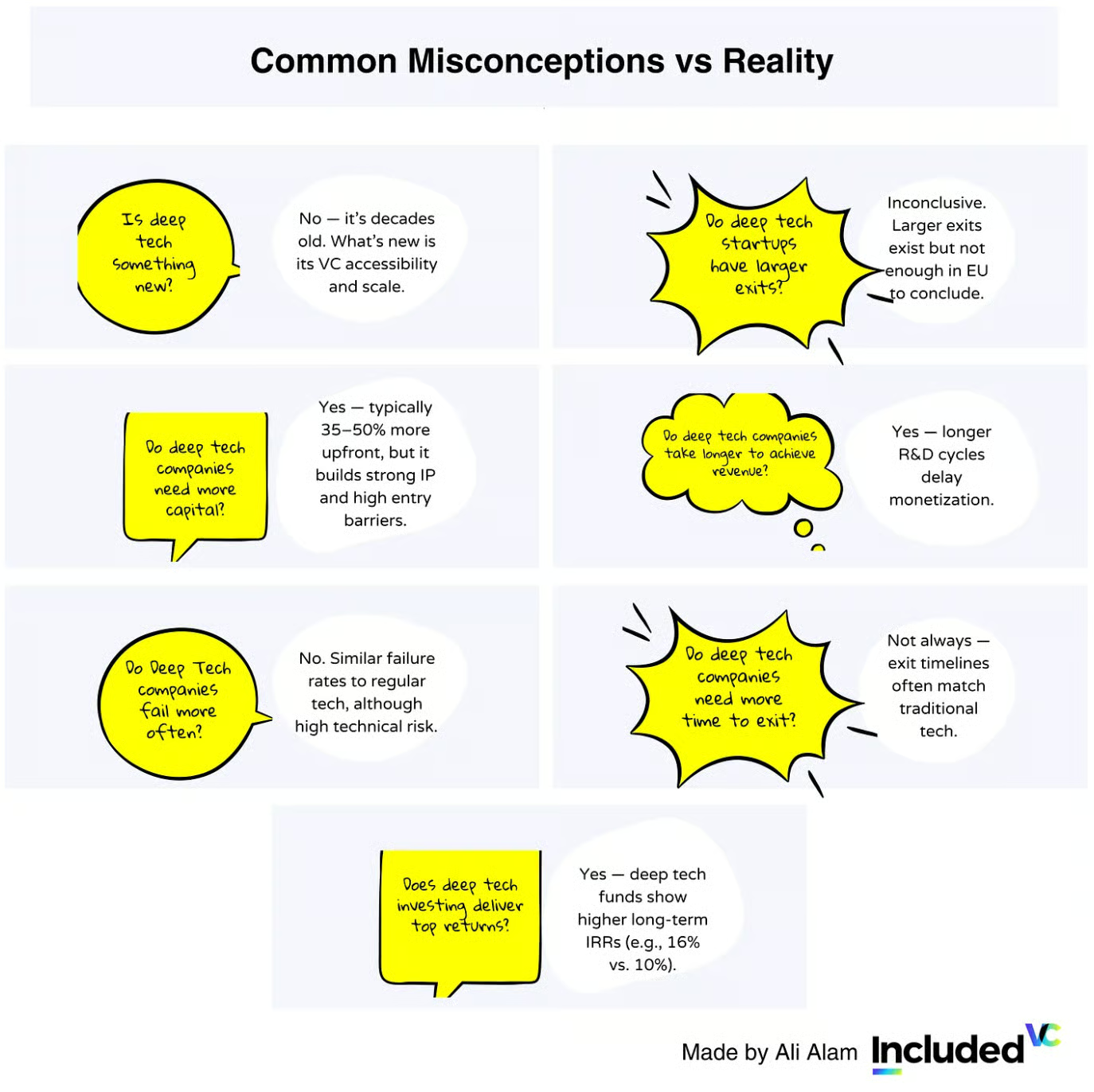
Deep Tech is the genesis of venture capital and has historically been fundamental to regional sovereignty by catalysing technology megatrends. Although its development typically requires higher initial capital, this investment is primarily directed at building robust intellectual property moats that act as significant barriers to entry for competition. This approach allows for accelerated revenue growth once the technology matures.
Deep Tech portfolios have shown to outperform conventional tech portfolios, offering a hedge against momentum investing. Contrary to common perception, Deep Tech companies do not fail more frequently than others; their failure rates are comparable, albeit with a distinct risk profile focused on scientific uncertainty rather than market competition. Europe, with 6 of the top 20 universities and 9 of the top 25 research institutes globally, is strategically positioned to lead in this area.
VC updates: AI versus deep tech and hardware
For the first time, Deep Tech & Robotics (6.7%) has surpassed AI & Machine Learning (6.3%) as the sector attracting the most interest from venture capital investors in Q2 2025 surveys. This is a significant inflection point, indicating a broader focus beyond purely software solutions towards complex, hardware-based innovations that solve real-world problems.
While AI funding remains massive globally, an estimated $40 billion in Q2 2025 alone, representing nearly 45% of all global funding, its role is evolving. AI is increasingly perceived as a ubiquitous enabling technology, a new backbone, rather than the sole investment focus. The emphasis has shifted towards applied AI, where it solves specific industry problems and acts as an integral enabler within Deep Tech companies. For instance, advanced AI tools, including Transformer models, are now applied in robotics, biotechnology, and new material design (Dealroom Deep Tech Report).
The line between AI and Deep Tech is fading. Investors now favour hybrid models that merge hardware or science with advanced software, offering strong moats and solving real-world problems.
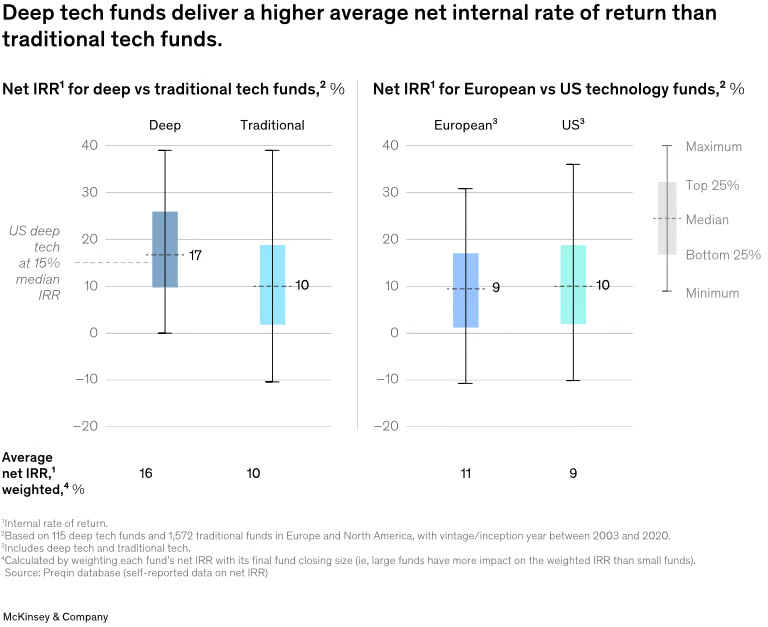
Deep Tech funds, due to greater resilience in market cycles, have shown better return profiles.
Deep tech particular dynamics
- Long timelines, high conviction. Investors are backing longer cycles and bigger bets; milestone-based de-risking is key to building real tech moats.
- Hardware needs more than equity. For CapEx-heavy Deep Tech, equity alone is not enough. Venture debt and asset-backed tools are gaining traction to fund infrastructure and scale responsibly.
- High tech risk, low competition risk. Deep Tech carries technical risk, but once built, it is hard to copy; defensibility is higher than in traditional software.
- Downturn buffer. Deep Tech fell just 28% from peak versus 60% in regular tech. It is increasingly seen as a hedge against hype cycles and short-term corrections.
- Strategic support on the rise. Europe is mobilising public capital, corporate alliances, and national policies to prevent talent and IP leakage, and to scale locally.
Key deep tech sectors
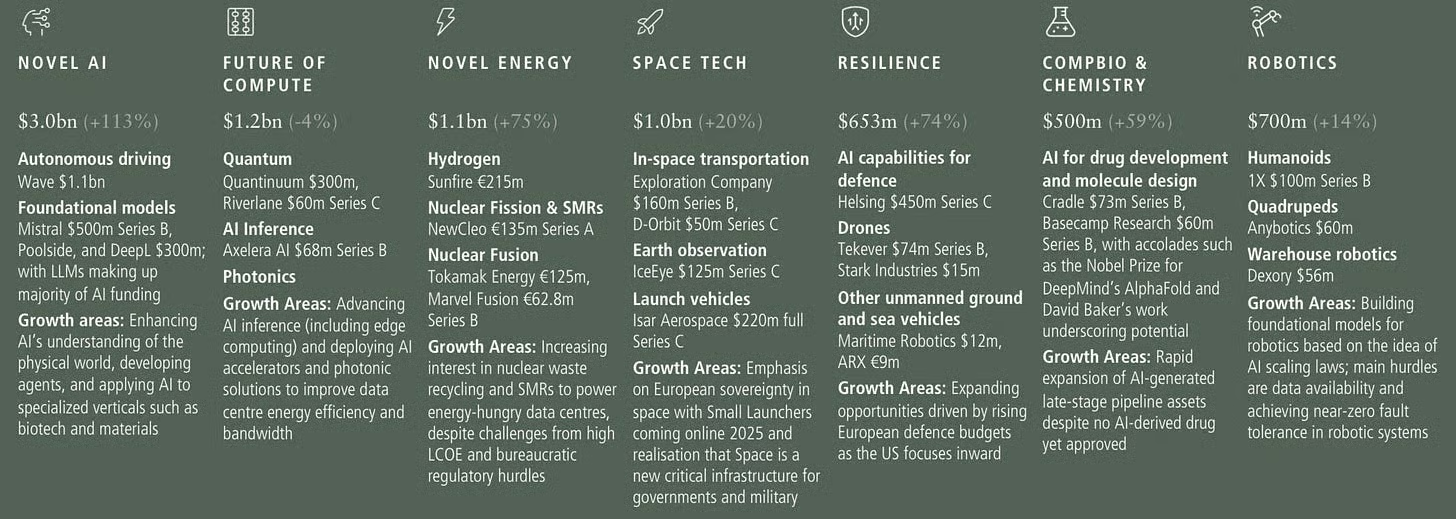
- Novel AI is on fire. $3bn raised, up 113% year on year. LLMs alone drew $1.5bn, a 10x surge. Europe's AI race is no longer generic; it is specialised, reasoning-driven, and unstoppable.
- Future of compute gets gritty. $1.2bn, down 4%, flows into quantum, AI chips and photonics. The war for compute speed and energy supremacy is on, and silicon photonics leads the charge.
- Space tech lifts off. $1bn, up 20%, as launch costs plummet. Space is no longer science fiction; it is Europe's new critical infrastructure.
- Robots are rising. $700m, up 14%, into humanoids, quadrupeds and warehouse AI. Embodied AI is making robots smarter, but data is the final frontier.
- Bio and chem compute explodes. $500m, up 59%, to rewire drug discovery and materials. From proteins to polymers, the lab now lives in the cloud.
- Novel energy surges. $1.1bn, up 75%, into fusion, SMRs, and hydrogen. Old nuclear is expensive; modular is the future.
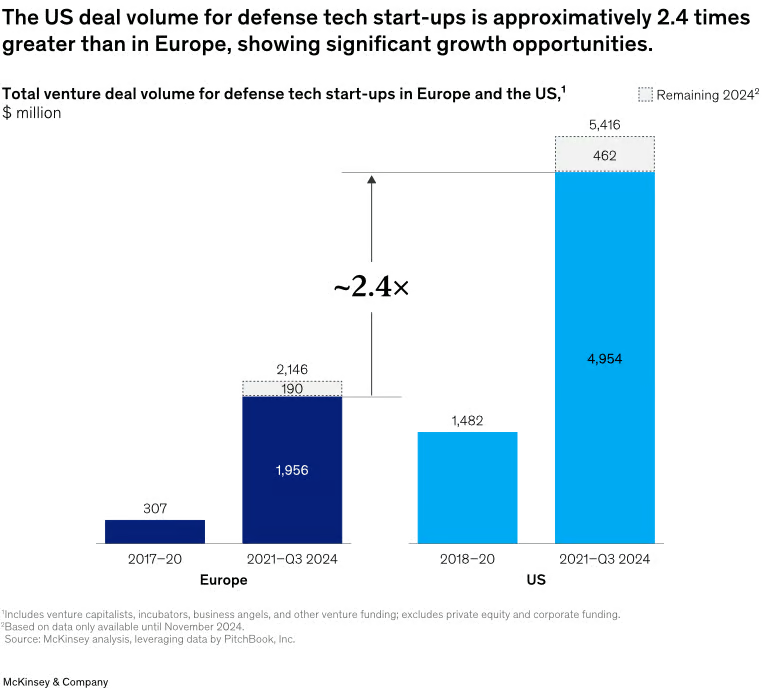
- Resilience becomes urgent. $653m, up 74%, into drones and dual-use AI. Defence tech is no longer optional; speed is survival.
The venture capital landscape still faces significant obstacles, with geopolitical uncertainty (7.5%) and cybersecurity threats (6.0%) identified as top concerns.
Women shaping the future of deep tech and robotics
Some of the influential female founders driving innovation in robotics and deep tech today:
- Hélène Huby, co-founder of The Exploration Company, a space tech startup developing reusable spacecraft and space logistics solutions to advance sustainable exploration beyond Earth.
- Carla Gomez Cano, co-founder of Theker Robotics, specialised in robotics, deep learning, and computer vision, with the capability to design, manufacture, and market autonomous machines for process automation in the industrial sector.
- Camilla Mazzoleni, co-founder of Xelerit, working on industrial automation using a suite of three AI agents: one to connect hardware, one to convert ideas into industrial-grade code and another to test, simulate and debug before going live.
- Karen Dolva, co-founder and former CEO of No Isolation, the award-winning telepresence robot helping children with long-term illness stay connected to school. Raised over €5m and backed by Idekapital. Named one of Europe's Top Innovators by Forbes and BBC 100 Women.
Key takeaways
- Deep tech shows resilience. €15bn went into European Deep Tech in 2024, down just 28% from its 2021 peak, versus a 60% crash in regular tech. It now makes up 28% of all VC funding in Europe, becoming the continent's largest VC category.
- Robotics and deep tech take the lead. In Q2 2025, Deep Tech & Robotics surpassed AI/ML as VCs' top focus for the first time, 6.7% versus 6.3%, highlighting a shift toward hardware-driven, real-world innovation.
- Bigger moats, longer runways. Deep Tech startups require more capital and time: on average, €392m to reach €100m+ in revenue, compared to €113m for regular tech. But this upfront investment builds strong IP moats and defensibility.
- Returns without extra risk. Deep Tech startups do not fail more often than others, and funds focused on them have outperformed traditional tech funds since 2003, showing stronger long-term IRRs.
- Novel AI booms, led by LLMs. Europe's fastest-growing Deep Tech segment in 2024 was Novel AI, doubling year on year to $3bn. LLMs alone drew $1.5bn, nearly 10x growth since 2022, making up half the total Novel AI investment.
Europe's venture landscape is betting on Deep Tech as a path to technological sovereignty and economic resilience. Investors are seeking companies that combine scientific breakthroughs with strong commercial potential, demonstrating that patience and a focus on fundamental, difficult problems can yield significant returns.
First appeared in our newsletter, July 2025.