The new normal
Global AI startups raised around $110bn in 2024, up 62% year on year, even as overall tech VC fell. The U.S. dominated: around 42% of U.S. VC dollars, $80.7bn, went to AI, while Europe drew $12.8bn, 25% of its VC. Europe was only around 12% of global AI VC, in what Dealroom called "the biggest wave ever".
This reflects a mindset gap that is beginning to matter and materialise. In technological revolutions, speed and execution matter. U.S. investors tend to back vision-first, market-creating bets, while European VCs skew metrics-first. This is not to say that Europe cannot innovate; in fact, U.S. funds are more present in European AI rounds this year. Investing activity from the U.S. ticked up in early 2025, especially in AI and deeptech, proving interest in European talent and innovation.

Some of these landmark financings include Isomorphic Labs' $600m led by US investors. Synthesia and ElevenLabs followed with around $180m each, also led by U.S. firms.
AI funding frenzy versus cautious capital
In the U.S., competition for AI deals has led to outsized bets at huge valuations. By mid-2025, the five largest VC deals, all AI-related, made up 36.7% of total U.S. venture funding, more than double the share a year earlier.

In Q2 2025 alone, the five biggest deals were all AI or AI-adjacent: Scale AI ($14.3bn), World View ($2.6bn), Anduril ($2.5bn), Thinking Machines ($2bn) and Safe Superintelligence ($2bn).

Giant funding rounds like Databricks's $10bn raise, valuing it at $62bn, and OpenAI's recent financing at a $157bn valuation have set new benchmarks.
Europe, in contrast, has seen much smaller deals. Its biggest AI financing of 2025 was Alphabet's UK-based Isomorphic Labs raising $600 million for AI-driven drug discovery, and even that was funded entirely by U.S. investors. Other top European AI startups like Synthesia and ElevenLabs raised on the order of $180 million this year, again led by large U.S. VC firms.
This dynamic is forcing European VCs to up their game in the AI era, balancing their hallmark diligence with a bit more Silicon Valley boldness, if they do not want to be left behind. Despite the flood of capital, investors are mindful that not every AI bet will pay off, which is making these months especially challenging for diligence-oriented VCs.
Enterprise AI: big tech bets and rising corporate investment
In this context, enterprises across industries are also racing to integrate, and tech giants are heavily catalysing this trend. One sign of how central AI has become for enterprise strategy is the rapid growth of corporate AI budgets.


This surge in enterprise demand is being enabled, and encouraged, by massive bets from technology leaders to build AI capabilities and infrastructure:
Notably, while European corporations are also exploring generative AI, the centre of gravity for enterprise AI enablement lies largely with U.S.-based platforms and providers. This raises the stakes for Europe to invest in its own AI capacities and regulatory frameworks, or risk relying on external innovation. But regardless of region, the message of 2025 is clear: AI in the enterprise is moving from optional experiment to operational necessity.
The closed capital loop
Amidst all these quick shifts, VCs also need to navigate the fact that AI's biggest players are now financially and operationally intertwined, creating a feedback loop that blurs the line between investor, supplier, and customer:

- Nvidia, $4.5tn market cap, is the centre of gravity, supplying GPUs to everyone and investing up to $100bn in OpenAI, whose massive compute demand drives Nvidia's growth.
- OpenAI, $500bn valuation, is not just a software company anymore; it is a capital magnet. It has a $300bn cloud deal with Oracle, a 6-gigawatt GPU deployment with AMD, which also gave OpenAI an option to buy 160m AMD shares, and heavy reliance on Microsoft, $3.9tn, its largest backer and cloud host.
- Oracle, AMD, and Intel all orbit this ecosystem, providing chips, cloud, and infrastructure while simultaneously becoming investors or vendors to one another.
- Emerging AI companies like xAI, Mistral, Figure AI, Nscale, and Ambience Healthcare receive backing or compute from Nvidia, reinforcing the cycle.
Healthcare: AI's surprising adoption leader
One of the most striking shifts in 2025 is that healthcare, historically considered a digital laggard, has emerged as a frontrunner in enterprise AI adoption. The $4.9 trillion U.S. healthcare industry, about one-fifth of the economy, traditionally accounted for only around 12% of software spend, but it is now deploying AI at more than double the rate of the broader economy.
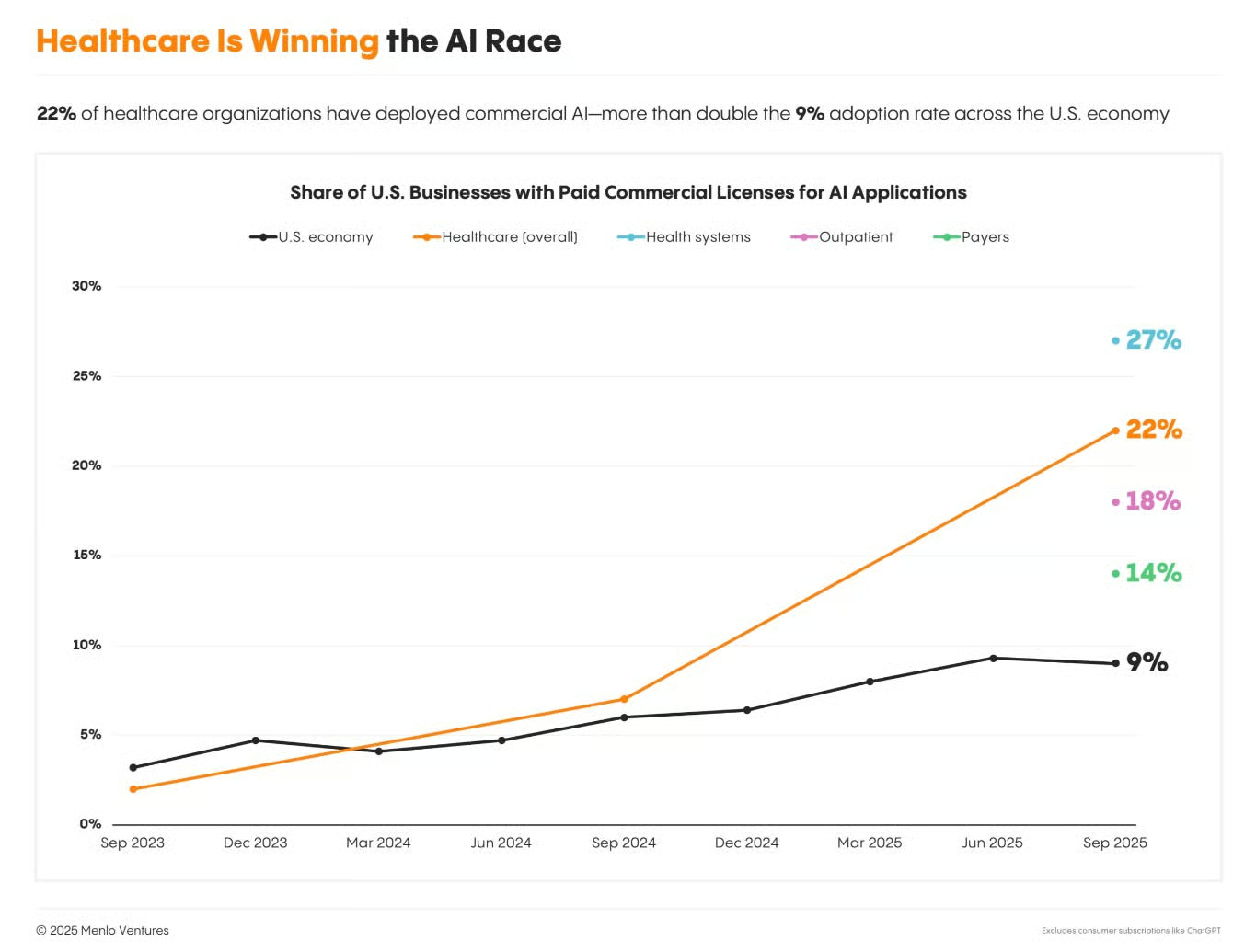
In just the last two years, healthcare went from roughly 3% AI adoption to become America's AI powerhouse sector. Today, an estimated 22% of healthcare organisations have implemented domain-specific AI solutions, a sevenfold increase over 2024 and 10x higher than in 2023. By comparison, fewer than one in ten companies in the overall economy, around 9%, have deployed AI tools so far, and those that have often rely on generic offerings like ChatGPT rather than industry-tailored AI.
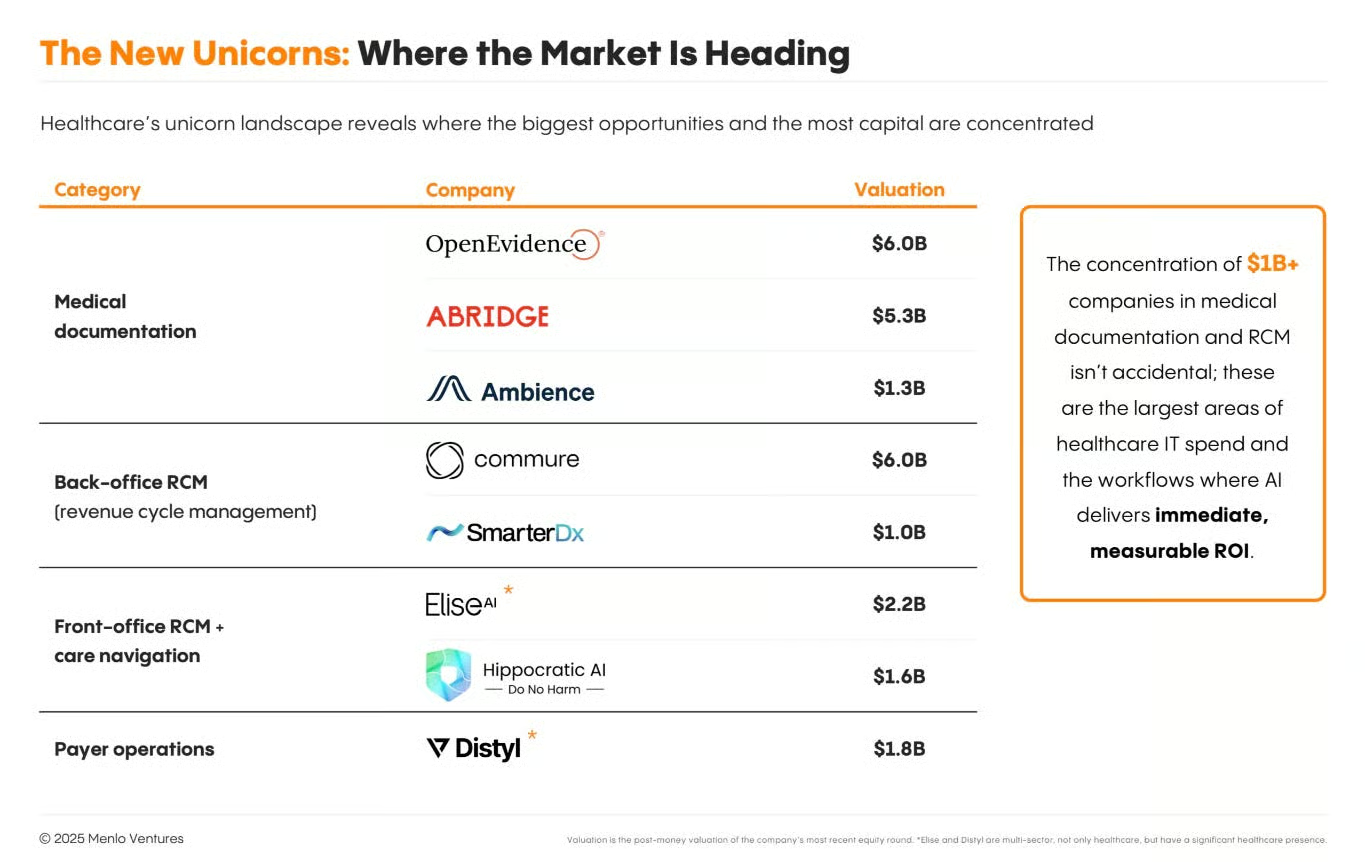
What is driving this rapid uptake? Simply put, the healthcare sector faces intense pressures, thin margins, labour shortages and burnout, rising medical costs, and long R&D cycles, that AI promises to help alleviate. These pain points have made AI a strategic priority for many healthcare leaders. Importantly, organisations are backing up the enthusiasm with real money.
Key takeaways
- AI capital concentration. Global AI startups raised $110bn in 2024, up 62% year on year, yet 42% of U.S. VC went to AI versus 25% in Europe, leaving Europe with only around 12% of global AI VC.
- Valuations keep rising. By mid-2025, the five largest U.S. deals, all AI, captured close to one third of total VC, more than double a year earlier.
- Enterprise AI is scaling. According to a16z's CIO survey, corporate AI budgets are projected to rise around 75% year on year, moving from pilot spend to core IT investment, and big tech is in the race.
- Healthcare AI is in the spotlight. Adoption jumped from 3% in 2023 to 22% in 2025, now twice as fast as the overall economy. Hospitals and insurers are deploying domain-specific AI at scale, proving how fast deep-vertical use cases can commercialise once ROI is visible.
First appeared in our newsletter, October 2025.