AI in 2025: a snapshot
Are we in one of the most exciting times to be alive in history? The disruption potential is even larger than that of mobile or the internet. There is no doubt that the global AI market is surging, reshaping not just how we live and work, but also how VC allocates capital, how policymakers regulate technology, and how startups are valued.
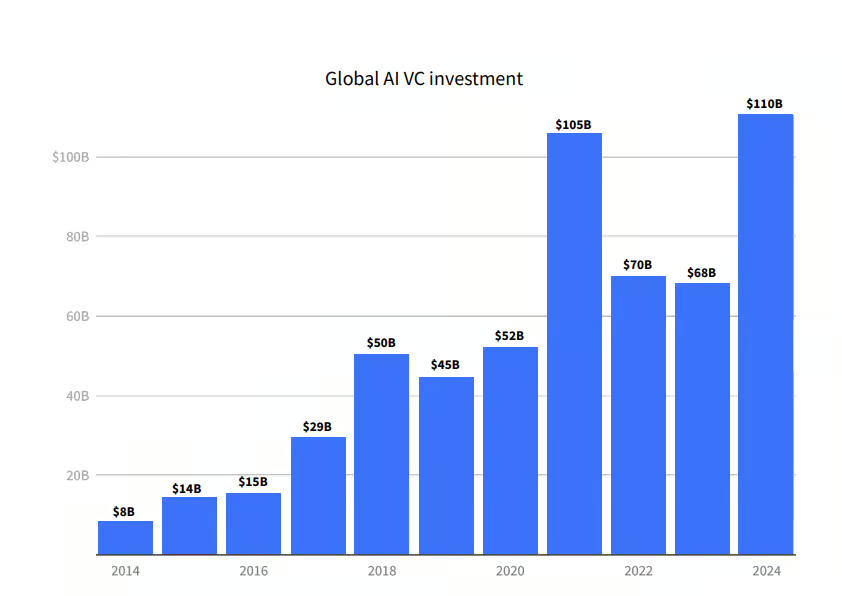
Despite market fluctuations and tight liquidity conditions, AI remains a dominant catalyst in venture markets. As of January 2025, global VC funding totalled $26 billion, with $5.7 billion, 22%, going to AI-related startups. This momentum builds on the $110 billion invested in AI throughout 2024, up 62% year on year (TechCrunch, Startups Magazine).
But here is the tension: Sequoia's David Cahn frames it as "AI's $600B question", a reference to the annual revenue that would be needed to rationalise today's infrastructure investments across chips, data centres, and energy. The bet is that AI will become so foundational that it generates this kind of economic return. But the gap between cost and realised value is still massive.
So the question is not just how much we are investing, it is what kind of future we are underwriting. Are we building systems that serve the broadest set of humans? Are we thinking beyond profit, toward durability, fairness, and long-term resilience?
The truth is, we probably do not know yet. The coming year will be pivotal in defining the trajectory of AI over the next decade.
Europe's position in AI: the race to strategic player
- In Q1 2025, European tech startups raised €11.6bn, a slight dip from €11.8bn in Q1 2024.
- AI startups accounted for €2.9bn of that, up 52% year on year from €1.9bn.
- Europe secured 12% of global AI VC funding in 2024, $12.8bn raised by European AI startups.
- Application-layer AI is where Europe shines: AI for pharma, logistics, legaltech, and industrial optimisation.
- Key hubs: London, Paris, Berlin, benefiting from a strong concentration of AI research talent and early adoption in corporates.
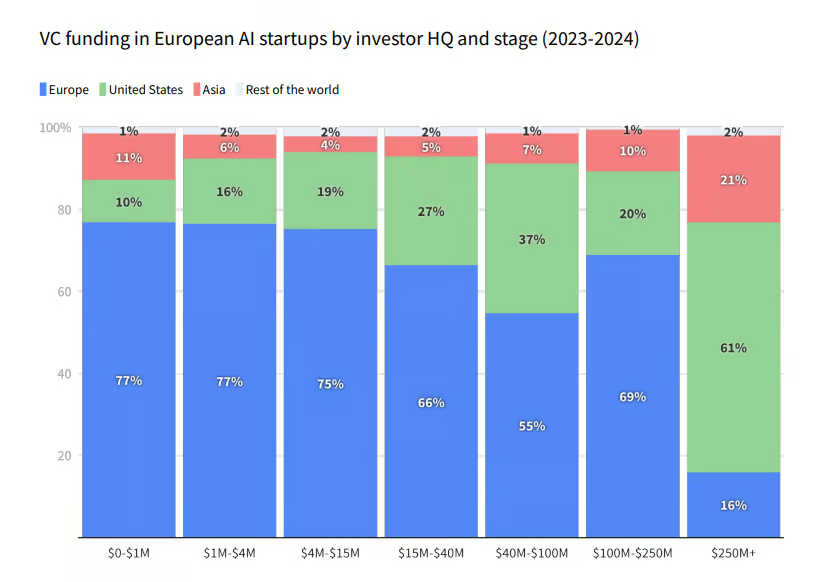
Meanwhile, the U.S. remains dominant with 74% of global AI VC, led by power players betting heavily on foundational models and infrastructure tools.
Women at the helm of AI innovation
- In 2024, 1,196 female-founded startups in Europe raised €5.76bn across 1,305 deals, down from €6.56bn in 2023 but mirroring the general 11% dip in VC across all startups.
- 25% of the top 50 AI rounds in Europe in 2024 involved female-(co)founded companies.
- 48% of Q1 2025's new unicorns in Europe are AI companies, a signal of sector strength.

Elin Mårtensson, Founder, AI-Bob
"Today, one-fourth of all money invested in construction projects is spent on correcting errors. In an industry worth over €12 trillion annually, this leads not only to massive financial losses but also to hundreds of millions of tons of unnecessary waste every year. That's when I founded AI-BOB, with the vision to prevent building errors before they even occur. My hope is that more women feel that spark of curiosity, that sense of urgency, to explore AI as a tool to solve the real-world problems they care about."

Oana Andreea Jinga, Co-founder, Dexory
"At Dexory, we're transforming warehouse operations through AI-powered robotics, providing real-time visibility and data-driven insights that enhance efficiency and safety. As a woman leading in this space, I believe our diverse perspectives are crucial in shaping technology that serves everyone. I'm proud to be part of a movement where women are not just participating in AI advancements but are at the forefront of driving meaningful change." Dexory secures $80m funding →

Raphaelle Taub, CEO and Co-Founder, Matricis AI
"AI gives us the unique opportunity to leapfrog outdated systems and address longstanding neglected areas and markets, like women's health. It compresses both discovery and its integration into care: insights that once took a decade of clinical research, and another to reach everyday medical practice, can now be generated and embedded into tools used by clinicians all across the world, and not just in top-tier research hospitals."
Interesting insight
"Did you know that there are only 6 self-made women billionaires under 40 on the planet? Six! And two of them are in AI." Zuzanna Stamirowska, Co-founder and CEO, Pathway.
Key takeaways
- AI is absorbing more VC than ever. 22% of global VC in January 2025 went to AI, sustaining momentum after a $110bn year in 2024.
- Europe is finding its AI niche. While the U.S. leads in foundational models, Europe is dominating real-world AI applications.
- Regulation is now a value driver. Startups with ethical guardrails and compliance baked in are more fundable than ever.
- Investors are shifting their lens. From speed and hype to profitability, safety, and productised value.
Want to learn more? Female Innovation Index 2025, Tech.eu · AI's Missing Link: The Gender Gap in the Talent Pool, Interface EU · 15 Female Founders in AI, Sifted · Mira Murati's reported $2 billion seed funding, Fortune · Cradle secures $73 million, co-founded by Elise de Reus · Aqemia secures $68 million, co-founded by Emmanuelle Martiano Rolland
First appeared in our newsletter, April 2025.