Venture is having its best year on record and its worst year in a decade at the same time. Which one you are living in depends on which side of the concentration line you sit.
In June we argued the gate on the AI build-out had moved from the chip to the electron: physical scarcity, not capital, was rationing the boom. For infrastructure that still holds. Step back up to the capital markets and the picture flips. Capital is superabundant. It is just moving through the narrowest funnel this industry has ever produced.
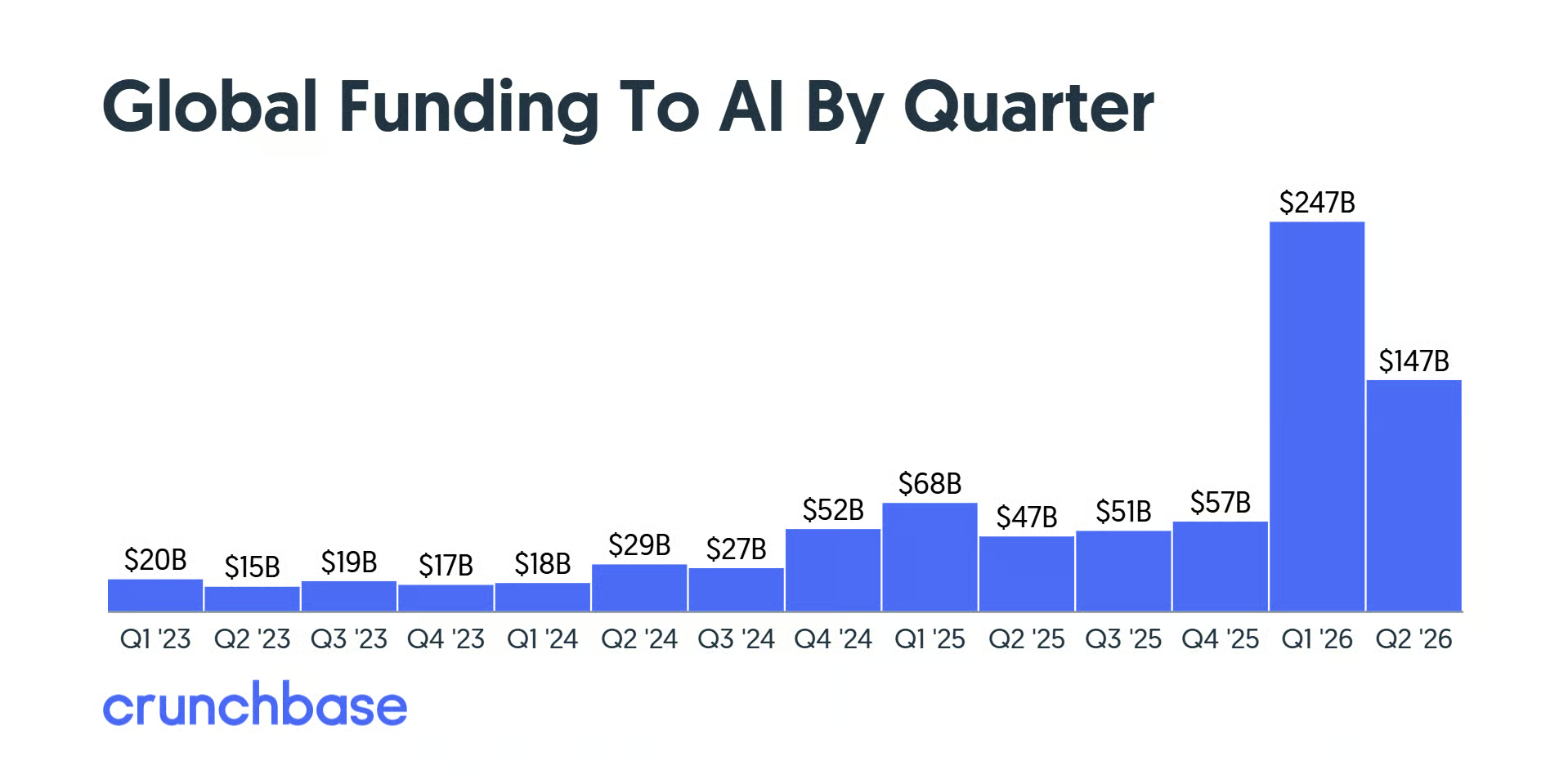
Crunchbase counts $510 billion of global venture funding in H1 2026, more than all of 2025 combined and the biggest half-year ever recorded. PitchBook-NVCA has US deal value at $412.7 billion in six months, above every previous full-year total. Exits woke up too: Q2 was one of the strongest quarters for venture-backed liquidity in years.
And then the other column. CB Insights has global deal count at its lowest level in more than a decade, new unicorn formation at a six-quarter low, and 263 mega-rounds taking 81% of all capital, with one company taking nearly 40% of a quarter on its own.
When the average and the median tell opposite stories, which one do you underwrite? The rest of this letter is our attempt at an answer, starting with what the record is actually made of, then following where the liquidity went.
The record is real, and about a dozen companies wide
The bull case first, because it is substantial:
- Funding: Q2 brought in over $205 billion globally, the second-largest quarter ever, behind Q1's $305 billion.
- Exits: 24 companies were acquired at $1 billion or above in Q2, $113 billion of M&A value, the biggest quarter on record. And SpaceX listed: PitchBook notes its $1.7 trillion IPO produced more exit value in a single quarter than the entire previous decade.
- The queue behind it: OpenAI and Anthropic have both filed confidentially for listings. Days after going public, SpaceX agreed to buy Cursor-maker Anysphere for a reported $60 billion.
Then look at what the record is made of:
- Two companies took 43% of everything. OpenAI and Anthropic raised $217 billion between them in H1. Anthropic's $65 billion round was, on its own, roughly a third of Q2 global funding.
- AI took over 70% of Q2 capital, up from just under 50% a year earlier. PitchBook has AI at 86% of US venture dollars.
- Sixteen billion-dollar rounds captured 53% of the quarter. Megadeals of $100M and above took 87.5% of all H1 dollars.
The K underneath
Move down the stack and every number changes sign.
Seed is contracting, hard. North American seed funding fell 27% in H1 while the headlines set records. Seed-to-Series A conversion has collapsed to roughly 9%, against a historical 15-20%, and nearly half of last year's seed financings were bridges rather than true progression rounds.
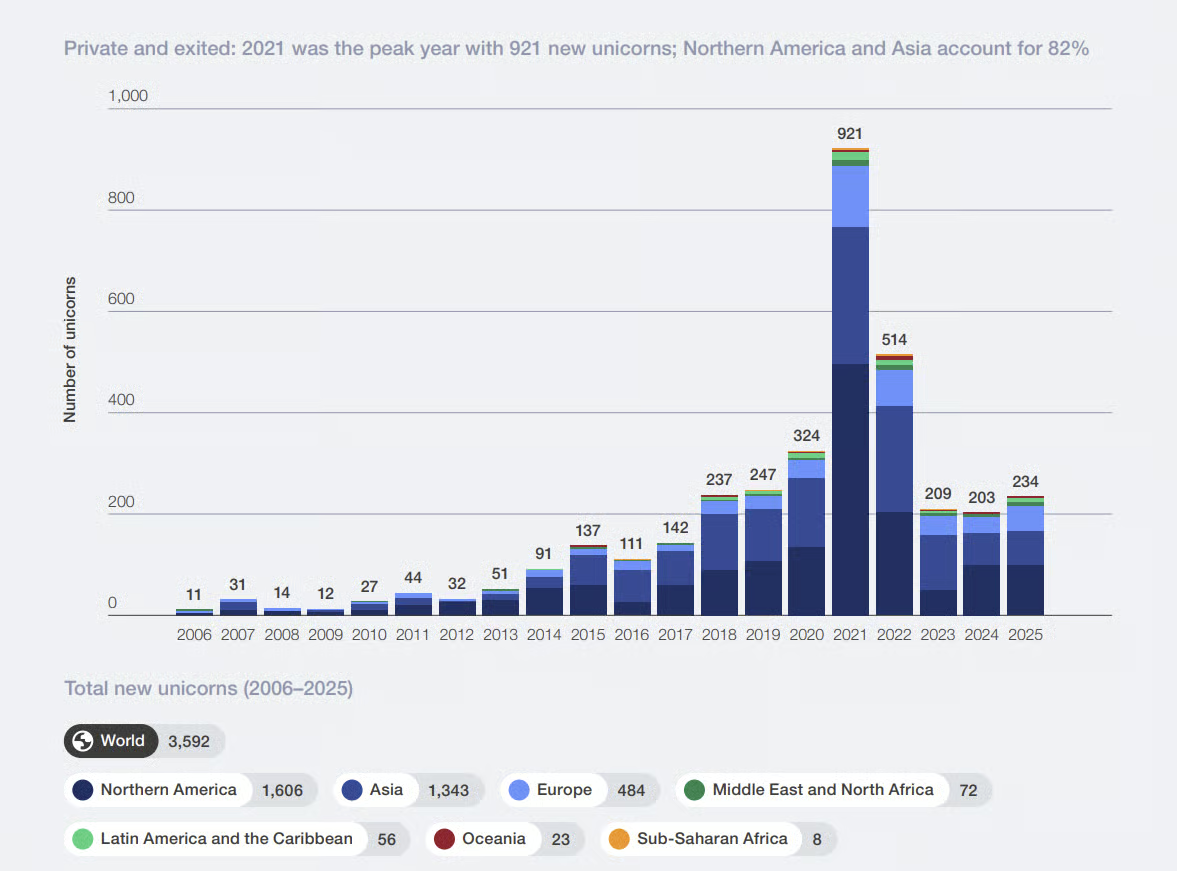
The backlog keeps aging. The WEF and Stanford GSB count 1,920 private unicorns globally; 59% are more than ten years old, 20% more than fifteen. A generation of paper value with nowhere to go. SpaceX's exit did not so much open the IPO window as show how high the sill now sits.
The most structural number of the quarter, though, is on the supply side. Three firms (Andreessen Horowitz, Thrive and Founders Fund) took 48.1% of all VC capital raised, while first-time fund formation tracks toward its lowest year since 2016. Wellington puts the top five managers at 73.1% of Q1 venture commitments, the top fifteen at 88.5%. Institutional LPs sent 91% of new Q1 fund commitments to established franchises, up from 74% a year earlier. Emerging-manager fundraising fell about 35% year over year, to its lowest level since 2020.
Why we care about that more than any funding stat: emerging managers write the $500K-$5M cheques. Mega-funds can't; deploying a multi-billion vehicle through seed cheques is arithmetic that doesn't work. So when LP dollars leave the emerging-manager layer, seed dries up mechanically. No sentiment shift required. It is plumbing, the same word we keep using about Europe, and not by coincidence.
Liquidity is back, for the 1%
Liquidity has genuinely returned. Through two doors, and only one of them is public.
Door one, the mega-exit: SpaceX, the $113 billion M&A quarter, two confidential AI filings. Historic, and available to a vanishingly small set of cap tables.
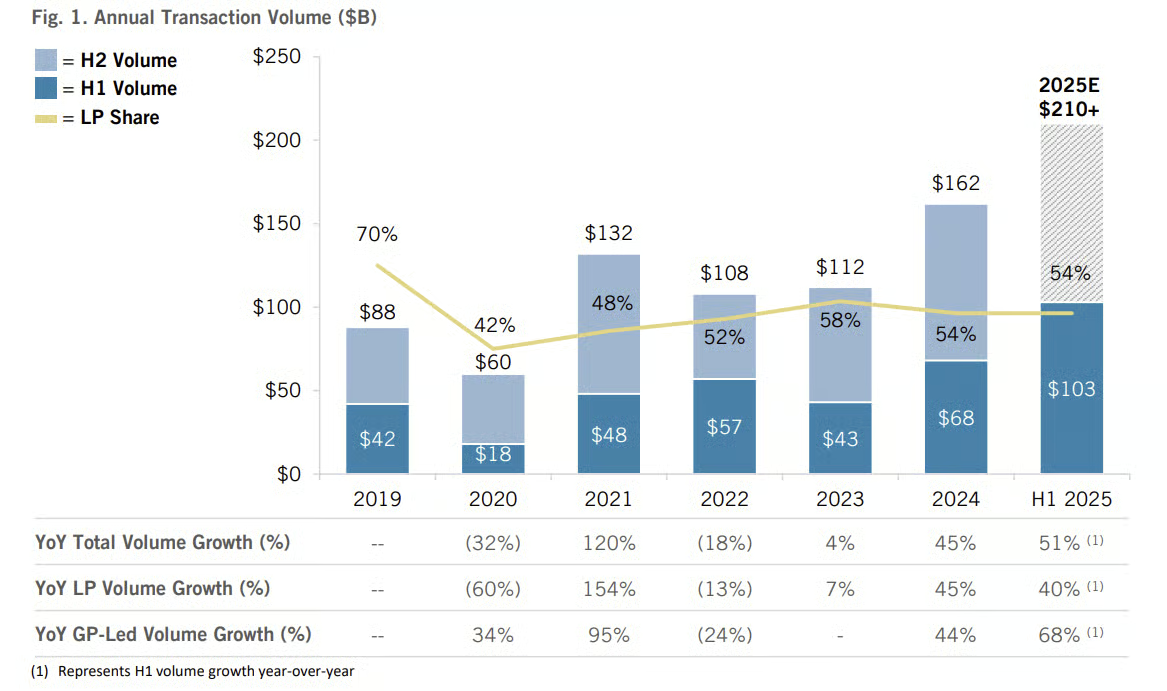
Door two, the secondary market, which is where everyone else now queues. Jefferies recorded $240 billion of secondary volume in 2025, up 48%, expects H1 2026 alone to clear $100 billion on backlog, and sees a path to $300 billion a year within 12-24 months. EquityZen pencils roughly $250 billion for 2026. Venture secondary pricing has recovered to about 78% of NAV, which is a functioning market, not a fire sale.
PE is the starker mirror. While venture set records, US PE deal value fell 37.5% quarter on quarter to $177.3 billion. PwC counts H1 deal volume down 34% with average deal size up nearly 4x: the same barbell, one asset class over. With conventional exits jammed, continuation vehicles have gone from tool to default. Nearly 80% of the top 100 sponsors have now done one, GP-led deals hit $115 billion in 2025, close to half of all secondary volume, with CVs making up 89% of it, and projections circulating in the LP community put CVs at 30-40% of all PE exits by 2027.
Worth pausing on that last one. In a CV the GP sells the asset and buys it, at a price anchored to a NAV the GP itself marks. Plenty of these are done well. But when manufactured liquidity approaches a third of all exits, “DPI is the new IRR” is no longer a T-shirt slogan - it is how the industry runs. LPs have noticed: fundraising now splits cleanly on demonstrated distributions, and 47% of LPs say they closely watch how their GPs use AI across investing and operations.
The European question
Europe's H1 is the best in years. It is also the same story, one size down.
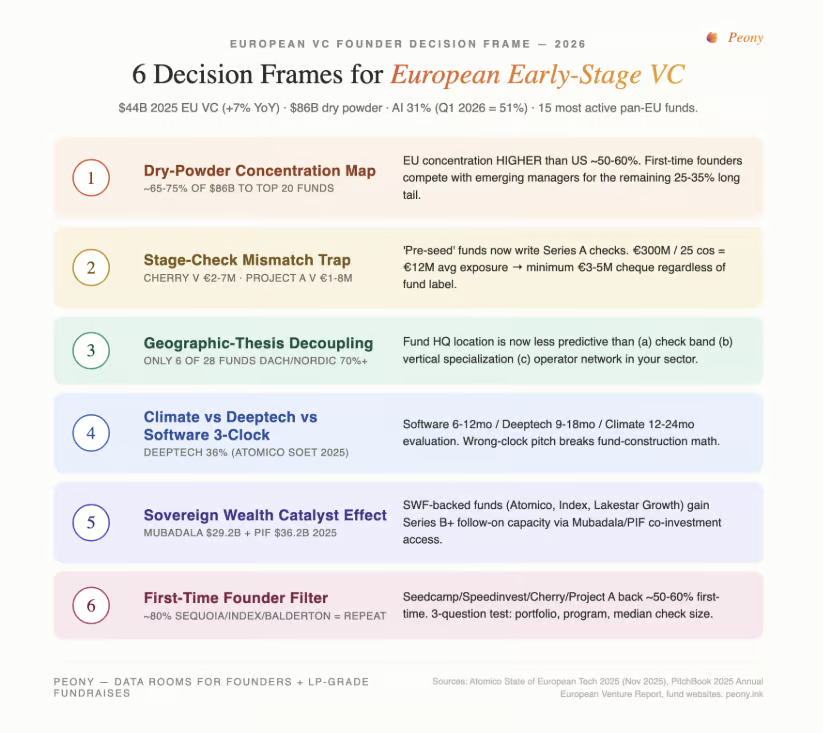
Crunchbase has European H1 funding at $42 billion, up 50% year over year, with Q2 the strongest quarter in four years. Sifted counts eight European $1bn-plus rounds in H1, an all-time record. The UK alone raised $10.4 billion in Q2, within sight of its 2021 peak.
The composition will sound familiar by now. 65% of Q2 European funding went to 42 companies raising $100M-plus rounds. Four billion-dollar rounds (Isomorphic Labs, Stegra, Neura Robotics, Ineffable Intelligence) took a quarter of the region's quarter. AI crossed 50% of European funding for the first time in Q1, a quarter in which overall deal volume fell 40% year over year and seed fell 44%. And for scale: North America raised $392 billion in the same half. Europe's record is 11% of the neighbour's.
Europe is finally producing companies that can absorb billion-dollar cheques, which is genuinely new. At the same time it is importing the concentration structure described above, with thinner scaffolding underneath. European pension funds still allocate roughly 0.01% of assets to venture, which leaves the emerging-manager layer hanging off a handful of public anchors (EIF, British Business Bank, Bpifrance, KfW) at precisely the moment private LPs herd into mega-franchises.
And the part this community cannot outsource: LP concentration is not neutral. Women-led and first-time funds sit overwhelmingly in the emerging-manager segment, the one absorbing the 35% fundraising decline and the 91%-to-incumbents commitment share. When capital formation concentrates, who gets to allocate capital concentrates with it, and a decade of slow progress on GP diversity gets quietly repriced. June's letter celebrated THENA Capital, the first all-female GP fund backed by the ECF programme. In this market it is also a measure of how much scaffolding one such close now takes.

Some thoughts to keep in mind
- The concentration might be rational. If frontier AI really is winner-take-most, routing 43% of global capital to two labs is efficient allocation, and the “mirage” framing has it backwards; the aggregate would be leading the market, not misdescribing it. The next 24 months of model economics settle this one.
- The decade-low deal count will be revised up. Seed rounds report late; Crunchbase itself flags that early-stage totals grow well after a quarter closes. The direction is real. Distrust the superlative.
- The bottom of the barbell is quietly having a great year. Decile Group's data shows February to May 2026 among the strongest months for sub-$15M emerging-fund closes in four years, with about 90% of LP commitments going to lean, specialist, seed-stage vehicles. The kill zone is the undifferentiated $50-300M middle, not the micro-fund. The K exists on the GP side too.
What we are watching next
- The OpenAI and Anthropic listings: whether two confidential filings widen the IPO window, or absorb what public-market appetite remains.
- Vertical AI as the counter-trade: the strongest rebuttal to the mirage thesis is coming from the application layer. Legal AI leads: Harvey raised $200M at $11 billion in March, 3.5x its valuation of a year earlier on roughly $190M of ARR, while Sweden's Legora hit $5.6 billion after crossing $100M ARR, adding Nvidia's NVentures and Atlassian to the cap table. Isomorphic Labs' billion-dollar round puts drug discovery in the same lane, and Europe is genuinely competitive here. Watch whether revenue keeps pace with valuations that already exceed the size of the markets these companies operate in.
- Secondaries vs the $100B H1 marker: Jefferies' backlog forecast, and whether venture pricing holds above roughly 78% of NAV as supply floods in.
- The CV share of PE exits: does it actually reach 30-40%, and do LPs convert conflict concerns into term-sheet power (independent pricing, fee resets, rollover terms)?
- The LP commitment mix: 91% to incumbents is the single number we most want to see mean-revert. If it doesn't, the 2028 seed vintage is being written now, by omission.
Extra read
Market pulse: corporates & innovation
The June report from Currence and HSBC, Offtake to online: how corporates drive innovation, is a useful reminder that for one corner of the market there is a third source of capital, and it doesn't run through a cap table at all: the customer.
It matters most for exactly the segment the K squeezes hardest. Climate and industrial deep tech have slid down the venture stack; climate is down to 18% of European VC dollars from 32% in 2023, and the Series B gap there is well documented. The report's core finding is that for first-of-a-kind projects, the financing that matters is no longer the next equity round. It is the offtake agreement: firm, contracted demand is the single biggest factor in whether a FOAK can raise anything beyond grants and venture.
Infinium's Texas e-SAF plant landed project finance from Brookfield and project debt from HSBC on the back of a ten-year take-or-pay with IAG (HSBC sponsored the report and provided that debt, for what it's worth). Google's 115MW PPA at $107/MWh took Fervo from a 3MW pilot to a bankable 200MW-plus geothermal pipeline. Demand, contractually committed, now does the work a missing Series C used to do.
The buyers writing those contracts are the very companies the concentration created. Data centres, cost-insensitive and desperate for speed-to-power, are reportedly paying up to $150/MWh for clean, firm, rapidly available power, a premium of roughly $50/MWh that the report sizes at $5-40bn a year of potential new spend. RE100 members alone imply $27-65bn a year in renewable procurement by 2040; mandated SAF demand adds $5-15bn by 2030, roughly 20x today's level. The same AI trade that hollowed out the equity middle is minting the most powerful offtakers climate tech has ever had, which is also the demand side of the grid story we told in June.
What we are reading
- PitchBook-NVCA Q2 2026 Venture Monitor — the records-at-the-top, contraction-underneath dataset this letter is built on.
- CB Insights, State of Venture Q2'26 — deal count at a decade low.
- CAIA on the continuation-vehicle boom — structural shift or liquidity patch?
- WEF and Stanford, The Future of Venture Capital — the aging unicorn backlog, in charts.
- Currence and HSBC, Offtake to online — how corporate demand finances what venture no longer reaches.